A marvelous, marvelous innings by Graham Thorpe. A masterful innings.

When Bob Willis uses words like marvelous (twice) and masterful, you take note. I was watching – though on Sky Television, on 2nd April 2004 when Graham Thorpe played his best innings.

I know Willis was more positive than his TV persona but he did not he throw praise around unless it was deserved. For Willis to react in such a way shows the brilliance of Thorpe’s 119 not out.

That tour of the West Indies in 2004 was a vital stepping stone for this England side. It was the highlight of Steve Harmison’s England career (see 7/12 at Sabina Park, Jamaica) and the emergence of England’s 4 prong pace attack for the 2005 Ashes. England made the decision to go with Geraint Jones instead of Chris Read following Alec Stewart’s retirement. Ashley Giles started to show how many runs he could grind out at number 8. Andrew Flintoff was established and growing in stature. We started to see what Michael Vaughan wanted his team to look like – except for the middle order. The likes of Andrew Strauss, Rob Key and Ian Bell would all emerge over the next year, but at that time England relied heavily on 3 ‘old pros’ – Mark Butcher, Nasser Hussain and Graham Thorpe.

It is worth noting that all 3 made vital contributions to that 2004 series win yet none would make it to the 2005 Ashes and they all must have known that they would be replaced before too long. Butcher was very unfortunate with injuries. Hussain ran out Andrew Strauss but still went out on a high. Thorpe got the closest to the Ashes and I would have played him that great 2005 series instead of Ian Bell. But Thorpe’s Barbados century was ‘classic Thorpe’.

For England fans, Graham Thorpe was a constant beacon of hope during the 1990s. His career seemed to have 3 phases – which spanned both of Brian Lara’s World records – Thorpe was on the field for both.

1993 to 1998

I know he was dropped in 1994 after the West Indies tour to make room for Graham Gooch and Mike Gatting but Phase 1 goes from 1993 to 1998. He made an impression early with a hundred on debut but early in his test match career he got criticised for scoring a lot of 80ish scores. I was always baffled because in those days an England 80 was pretty significant. In Australia in 1994/5 Thorpe was England’s best player. By 1997 he was a complete test match player and I always liked him at Number 5 behind Stewart and Hussain.

Emma John notes in her book ‘Following On’ that Thorpe reworked his technique after the 1994 West Indies tour to include that unique pull stroke which was so important to Thorpe over the years.
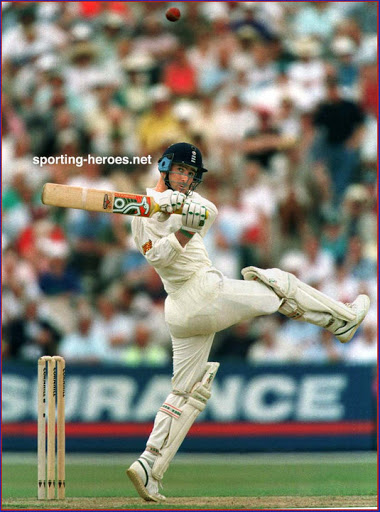
One leg in the air, the pull stroke. Thorpe felt the traditional England back foot push was not a good option and he needed a back foot game – it worked for him as he made a century at Perth. Picture from http://www.sporting-heroes.net/cricket/england/graham-thorpe-2047/test-record-v-west-indies_a02115/

1999 to 2002

During this period Thorpe missed a lot of games. His career would be restricted by a back injury and his well documented personal issues. I honestly believe Thorpe would have been better supported by the 2020 England management and would probably have played 15 more test matches.

The strange thing was that he still scored runs when he did play, and this period featured an amazing innings against Pakistan in Lahore featuring just a single 4. He also made his top score of 200 not out against New Zealand in March 2002 – that was a game where Nathan Astle would knock off another 200. One thing to note about Thorpe’s 200 was that Flintoff would make his first test match century in partnership with Thorpe. I am certain Thorpe would have been a real help to Flintoff.
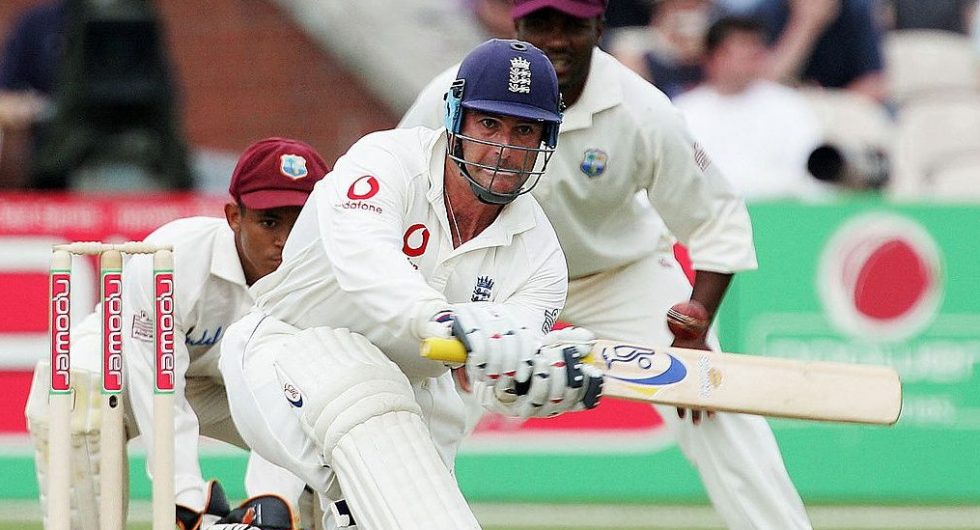
Thorpe was also a fine player of spin and had some success against Shane Warne as well as in Pakistan and Sri Lanka – Picture from Wisden.

2003 to 2005

Thorpe made the dream comeback at The Oval against South Africa with a fine century which some would say was a better knock than the Barbados one. He then had a brilliant run of scores, and Wikipedia notes that in the two years between his comeback and his retirement he scored 1635 Test runs at an average of 56.37.

In this period, Thorpe played a bit differently. In his early career he would counter attack, usually coming in at 50 for 3. That led to all those 80ish scores. By the end of his career, Thorpe knew that once he had dug himself in, he could stick around.

Barbados brilliance

Thorpe scored 119 not out out of 226. England were 119 for 6. Thorpe and Harmison shared a last wicket partnership of 39 but Harmison scored just 3. Butcher and Flintoff played loose shots. Hussain was bowled attempting an off drive. Nobody looked comfortable other than Thorpe – though he did have to dig his way in.

As England increasingly looked destined to fall short of the West Indies 224, Thorpe got more innovative. He walked down the crease to get his hundred. He unfurled a reverse sweep at one point. He got lucky with an early pull, but then played it to great effect. That little clip off his legs for 2 was a crucial shot.

As Emma John pointed out in her book, Thorpe was a really respected member of the England team. The reaction to Thorpe’s hundred here allowed an outpouring of that respect. Even the West Indians in the crowd were standing up when he walked into the dressing room.

In the last 20 years, England have had some fine middle order players. The likes of Bell and Joe Root come to mind. But Thorpe made runs against the best bowling attacks of the time. Amongst the players I have watched Thorpe would be one of England’s best left handed middle order players, second only to David Gower.
GP Thorpe: 1st August 1969 – 4th August 2024

I wrote a tribute to Graham Thorpe soon after I heard of this death. But I felt I had ‘missed the spot’ so I took it down. A few days later I realised that the entire cricket world might have missed the spot.

Graham Thorpe died of multiple injuries following an attempt to take his own life. It was not his first attempt and, as a result, he had spent time in hospital in the past. The cricketing world went from sadness to a deep sense of mourning. One cannot escape feeling that cricket failed Graham Thorpe, who clearly did not realise how much he was loved and respected by cricket watchers – particularly a certain generation of England fans who watched England in the 1990s. Cricket has a responsibility to Thorpe’s family to try not to fail any more cricketers. Wider than that, we ALL have that responsibility not to fail each other, because any of us could fall into the kind of spiral that Thorpe suffered.

I would not want to talk about Graham Thorpe’s challenges in his personal life. That is not my place. I recommend you read Thorpe’s book to find out more about that. All I would say is that many people respected Thorpe because he faced the type of difficulties many other people face. I do not think anyone would claim he got it all right – who does? – but that is not really the point. Seeing a gifted sportsman face the challenges of every day life and do his best to get through them was quite powerful. Thorpe was the first cricketer I know of who wanted to share some of that for the good of future generations. Marcus Trescothick and Jonathan Trott would follow suit in later years.

Unlike seemingly all of Thorpe’s teammates, I cannot share that experience of chatting to Thorpe over a glass of wine in a hotel room. I never even met him, though I once patted him on the back as he walked off the ground. That is as close as I ever got. But one of the trends in other tributes from people that got close to Thorpe is that he was great to talk to. Nasser Hussan talked of going to Thorpe on his darkest days. Joe Root said that Thorpe had an ability to make things simple (paraphrased). I think it might be a common trend. Perhaps to people facing ongoing mental health challenges, winning and losing a test match or scoring a pair at Lords does not seem top priority. Certainly, I cannot think of a cricketer that seems to have been so popular with other cricketers – whether that might be teammates or people whom Thorpe coached.

I have sat and watched many highlights of Thorpe batting in the last couple of weeks. He used to come out with this serious and stern expression in his eyes, and I used to take comfort as an England fan. Thorpe will sort it out – it was usually 20/2 or 50/3. Looking back, I think it was a facial expression that betrayed a certain nervousness – but I did not see that at the time. I just saw England’s best player of the time – because I am very much an England fan of that generation who came to have such respect for Graham Thorpe.

So my memories will be the cricket – and despite the sad circumstances of Thorpe’s death, we should not forget the cricket. I watched the highlights of Thorpe’s debut hundred in 1993, and in 1994 and 1995 I was really getting into it. Thorpe always seemed to come out and get 70 – and he was actually criticised for not getting hundreds. It seemed harsh to me – in the 1994/5 Ashes, Thorpe did score a hundred – one of only two England players to get to three figures in any of the Ashes test matches, the other being Mike Gatting. But by 1997 the hundreds started to come – memorably against Australia in 1997 at Edgbaston. Thorpe shared a massive partnership with Nasser Hussain who also scored a century – it cannot be a coincidence that some of Hussain’s best efforts came in partnership with Thope. I will never forget watching that test match – the 13 year old Edward really did think we were going to win the Ashes. The Aussies got it together and eventually won 3-2 – the closest Ashes series between 1986-7 and 2005 – and Thorpe had a fine series.

The late 90s saw Thorpe face personal difficulties and back problems, but by 2000 he was a proper player – not just someone who made nice 80s. He scored an amazing hundred in Pakistan featuring only 1 boundary, got England over the line in the dark and had a fine tour of Sri Lanka. A year later, he scored England’s quickest ever double century at the time – against New Zealand. What versatility. Then another enforced break before his twilight turn – a final 18 month run in the England side where Thorpe scored runs galore – most memorably in Barbados in a performance that Bob Willis said was marvellous and masterful. Its the Edgbaston and Barbados innings that I remember the best.

After such a fine career, he became a coach and was clearly popular. That he had such an impact on the career of Joe Root – both in spotting him and getting him on the India tour in 2012 and in getting Root to be more ruthless leading to big scores since 2020 – is an amazing achievement in itself. Thorpe clearly faced his own demons for many years, but it seems that while he was in the team environment he was able to get the best out of life. It seemed brutal at the time when Thorpe was sacked as batting coach after a horrific away Ashes series. Yes, England’s batting was awful, but everything about that tour was extremely difficult because of Covid restrictions. It seemed like Thorpe was the wrong victim, but in the context of that tour, perhaps nobody should have been a victim. Imagine the impact Thorpe might have had on the Bazball era. Instead, Thorpe was sacked. It surely cannot be a coincidence that a few months later, he was in hospital. After an horrible tour combined with the loss of that dressing room environment, I wonder what support was given?

Nasser Hussain showed real emotion when he said on Sky that his greatest sadness was that he was not around for Thorpe’s darkest days. I do not think Hussin should blame himself, but I do think Hussain would want us all to learn a lesson. Are we around for our friends on the darkest days? We cannot fix every problem for our friends, but we can at least try.

It is the batting I will remember.

First Test Match: England v Sri Lanka – Day 1

Sri Lanka 236 (Dhananjaya 74, Woakes 3/32) England 22/0 (Duckett 13*)

I attended the first day at Old Trafford today.  While it had some interest, overall, it was a tedious day that did not deliver value for money for paying ticketholders.

Firstly, we saw a terrible start for Sri Lanka who were reduced to 6/3. Gus Atkinson and Chris Woakes were tight and brought about frustration from the openers. Mark Wood was again bowling fast – his first ball a mere 94mph, and Kusal Mendis got what Jonathan Agnew on the BBC referred to as a ‘horrible ball’. I am not sure what Mendis could have done as Wood got some steep bounce. Angelo Matthews inexplicably left a Woakes straight ball before Shoib Bashir profitted from some worrying low bounce, trapping Dinesh Chandimal LBW. It looked a typical Old Trafford pitch – except for the low bounce which is a mystery.

More wickets came after lunch with Prabath Jayasuriya unable to take advantage of a strange wicket off a no ball that was only called when the batter was almost off the field.  This brought together Dhananjaya de Silva and Milan Rathnayake who both played really well in a strong partnership. Ollie Pope set postive fields that Dhananjaya (74) and Rathnayake (72) profitted from, but retaining the leg slip led to the departure of Dhananjaya, who may well now wish he had gone for a big hit instead of clipping the ball directly to Dan Lawrence.

Up to this point, we saw lots of good cricket. Woakes, Atkinson, Wood, Bashir, Dhananjaya and Rathnayake all deserve a mention. The Sri Lanka top order were always going to struggle with the mostly good bounce – and the bad bounce, though the some of the dismissals were down to poor strokeplay and technique, as much as tight bowling. The first poor bit of cricket we saw was the wicket off a no ball. What made this unusual is that the no ball was for a third ball in the over being over height. The umpire had indicated two for the over, so Atkinson ought to have moved away from the bouncer. Luckily for Atkinson, it was not an expensive miss.

From then on, the quality of the cricket fell off a cliff for a myriad of reasons. Firstly, England kept dropping it short to Rathnayake, who, for a while, enjoyed one easy pull for over per over. We give Sri Lanka credit for getting up to 176/8, having been 92/6, but while Rathnayake played well, he was gifted some runs by England’s short ball obsession.

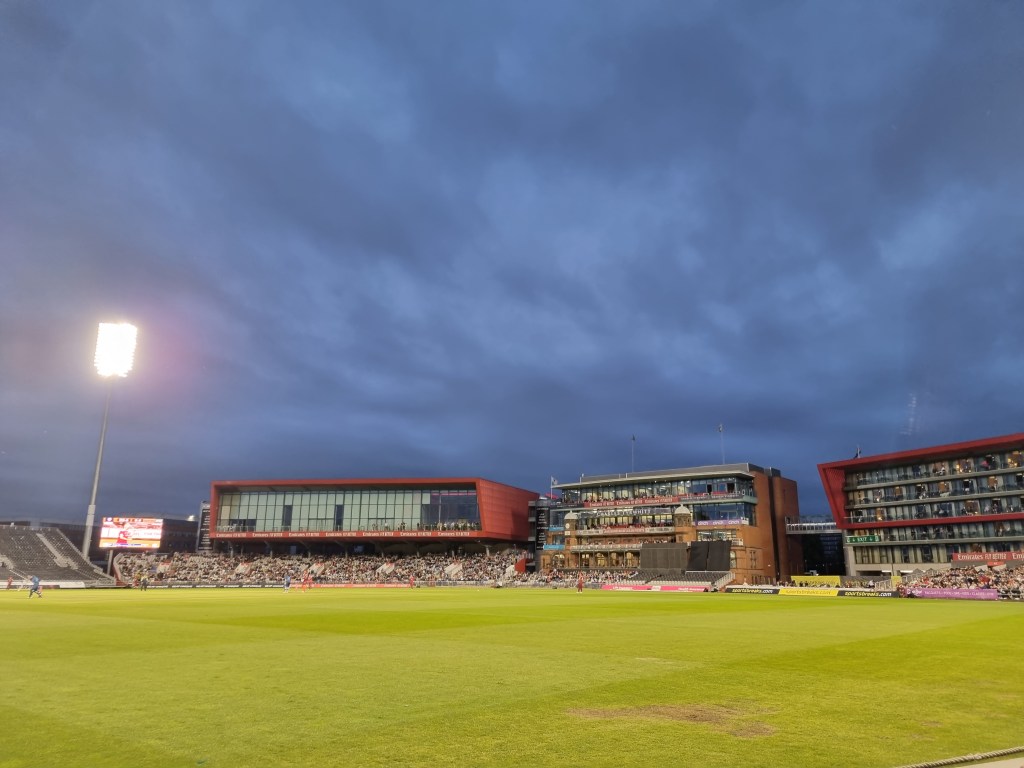
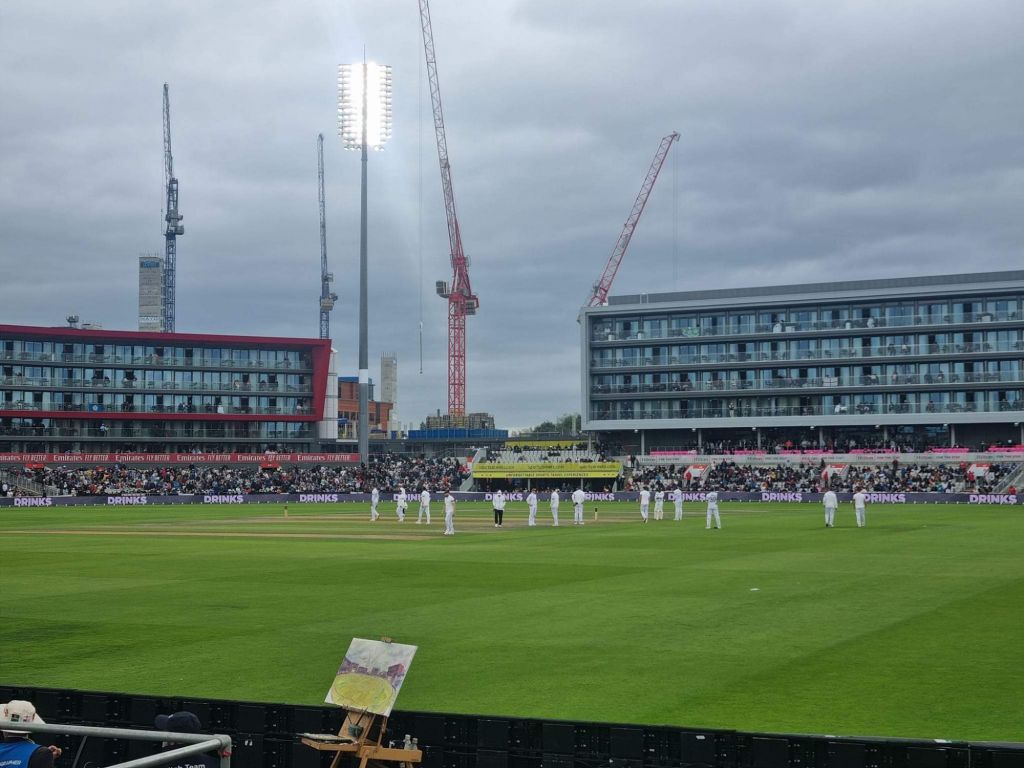
Ok it was pretty dark. But we have great big flood lights! And the artist could see to paint! It does present practical challenges but we cannot keep turning lights on and saying it’s bad light.

England should have finished Sri Lanka off before bad light became an issue – on two counts. Firstly, the over rate was so slow that England were way behind at lunch and tea where they should have been in terms of the number of overs bowled. It leads to a bored crowd. Secondly, England went for the short ball ploy. With Sri Lanka 8 wickets down, Pope made the same errors as Stokes, Root and Cook before him. What was needed was some straight bowling, but we saw one short ball every over and many seemed to whistle away through midwicket.

After a somewhat ineffectual spell by Matt Potts, whose bowling lacked the intent of the other seamers, Joe Root was inexplicably brought on when surely it was time for Woakes. From the crowd, it was not easy to tell when the umpires intervened exactly – this certainly needs an announcement through the PA system – but when Pope tried to bring Wood back, the umpires said no, Wood was too fast for the light. We found ourselves back in the farce where 4 fast bowlers were not allowed to bowl due to bad light – when all the flood lights were on. We saw this last year as well. I am sorry, but I can not comprehend how it can be bad light, with flood lights on and tail enders hitting fours. It makes no sense – you try and explain to someone who does not know much about cricket that test match cricket is the best format when we have this nonsense going on. You will not succeed.

Thus, we had the combination of slow over rate, strange captaincy, England’s choice of bowling short to tail enders and poor umpiring in relation to bad light all coming together to create tedium. I am certain the fast bowlers should have been allowed to bowl for longer, but equally, if the over rate had been up to scratch, we would have seen better cricket. The stewards were busy stopping beer snakes in the party stand – but we can not be surprised that the crowd are restless in these situations.

The one good bit of cricket late in the day was in the retention of positve fields, combined with tight bowling from Bashir and Root. England eventually got Rathnayake to go for a big hit, and he mis-cued before Vishwa Fernando and Asitha Fernando messed up the running, resulting in a final run out.

England were never going to prod and poke against Jayasuriya and Dhananjaya, so Ben Duckett, in particlar, and Dan Lawrence raced to 22/0, at which point Sri Lanka bought pace bowling on which resulted in the close. In the last half hour or so, the light was poor so this was perhaps fair enough. An hour earlier, though the light was not that bad and those big flood lights continued to shine. Yet we had to watch 14 over of easy spin, giftinh Sri Lanka an extra 20 or so runs.

My overriding summary of the day – if we have flood lights turned on, use them. If that means a different ball (pink or whatever), we need to go with that. Alternatively, bin the lights in test matches as they are totally pointless at the moment.

England will be batting in difficult wether today and I think they might live to regret not bowling Sri Lanka out for 150. Saying that, they probably will score 280, which will be enough to go on and win. 

County Cricket: Impossible to follow

Nobody really is thinking about the cricket fans.  All the talk is about player power, franchises and administrators. In the English domestic game, it’s all about counties and county chairs and The Hundred. My experience is that nobody is thinking about the fans and spectators.

I am a Season Ticker Holder at Lancashire. I have done the maths – once I go to a handful of T20 Blast matches and The Hundred, along with the discounted International Tickets, it’s not bad value for money. But my intention was to also go to lots of other games. However, its mid June and I have been to Old Trafford just twice in 2024.

County Championship

The only good thing about the fixture list at the start of the season is that the games started on Fridays and so took in both days of the weekend. And I suppose they did at least come after we changed the clocks.

The first fixture was against champions Surrey and should have been a wonderful fixture, but given that it started on the 4th April, it was almost certainly doomed to be a weather impacted draw. Its been a dismal season weatherwise, but early April in Manchester would be pushing it in the best of summers (though ironically would have been ok in the Covid summer of 2020).  The amateur football season was still in full swing, but despite my son’s fixtures, I was able to get to 2 sessions of this game – until the rain came.

Bizarrely, and frustratingly, we then had 2 away fixtures on the bounce (Essex and Hampshire – so not a realistic option for travel) so the next home fixture was in May, where Lancashire were battered by Kent. It already looked like Lancashire’s 4 day season was going to be grim).

This was followed by another away fixture against Nottinghamshire, before the next home fixture which was at Blackpool. This was actually a rare nice weekend (relatively), and Lancashire play the long form cricket better at the outgrounds. Lancashire played really well and deserved to beat Durham. This game was one I would have travelled to, and I was just unlucky with the diary. Typically, I could have attended the next round – the two consecutive away games cancelled out here by 2 consecutive home fixtures – but it was another rain ruined fixture against Worcestershire.

And that was that for the first part of the championship. Not much fun for fans, and totally pointless from the point of view of England selection.

T20 Blast

You would think it would be a bit easier to follow the T20 fixtures. However……

The first round was on the 30th May. It’s a good job it was half term given the 1900 start time for the men’s game. Lancashire rightly made a lot of fuss about this being a ‘double header’ with the Lancashire Thunder game. Thunder just got past Central Sparks, before Lancashire beat Durham well. The problam was the extremely long waiting time betweem the games – not at all family friendly. County Cricket can learn an easy lesson here from The Hundred.

The next evening, Lancashire were away at Worcestershire, where they lost, but I went to Taunton with my family to see Somerset play. We were on the way to Cornwall. The 1830 start at Taunton made more sense, and Somerset played well to just past Essex – it was a good night. It is worth noting, however, that this was also a double header, so the earlier start time clearly was possible even in the case of the double header. However, it was not a 1830 start everywhere – looking around the country on that night, games started at 1730, 1830 and 1900. I have no idea what time randomiser the ECB use for the fixture list, but the right time for fans is surely 1830.

The following week clashed with our Cornwall holiday. That in itself is fine, but its incredible to see Lancashire having 3 games in that week. Obviously, all three of those games were at different times of day.

What’s next?

Over the next week or so, Lancashire have 3 away fixtures in the T20 cup, before 2 rounds of Championship Cricket. One of these is a home fixture but its being played in Southport, meaning that no men’s cricket will take place at Old Trafford until 7th July when the men play Worcestershire again (they are away at Northamptonshire before this).  They have 3 consecutive home games – 2 in 3 days at one point, before the One Day Cup and Hundred take over.

How on earth fans can be expected to deal with all this is beyond me. I yearn for the days of a game every Friday night which we had in the early days of T20 and – do you know what? – it worked.

Blog Update

FOR some time now, I have been considering what to do about my blog sites. Below is a bit of a recap of the three blog sites I have created over the years, but firstly, a little bit of an announcement.

After a couple of years of relative inactivity on the blog sites, I am planning to wake things up a bit and will be making some new blog posts in the coming weeks. I will also be making a couple of little changes behind the scenes to allow me to update the look and feel of the sites and also to make it easier in the future to release new content.

Another important change is that I will be unlinking my blog sites from other other social media. What this means is that Facebook, LinkedIn and X will not automatically update when new content is released. The reason for this is that I have found that some blog posts are not suitable for all social media platforms. Therefore, I will manually post on relevant platforms based on the content being shared.

If you do want to follow my writings, the best thing to do is to Subscribe to the Website (it should be an option somewhere on the page) – stick in your email address and you will get an email each time I update something. If you are not into cricket – you do not need to Subscribe to that one, but you might want to subscribe to the more general content. You can also comment on the blogs on the site itself, as opposed to via other social media. However, I see all the comments – so whatever works for you.

Whether you subscribe or just look out for social media updates, I would love it if you would take a read.

Recap: What are my blog sites?

As a bit of a recap, I started writing in 2015 when I created http://charlottenotforgotten.wordpress.com/ after our daughter Charlotte was stillborn. I found it personally helpful to be able to share  something of my experience online. I hope it was useful to some readers as well – I believe that it was. However, I came to a point around 2017 where I felt I had shared everything I wanted to share about those events of 2015. Those events remain with me, but I felt I had nothing new to say. Since then, I have occasionally shared new posts, and I occasionally will continue to do so when it seems appropriate.

http://charlottenotforgotten.wordpress.com/

I also found that I wanted to write about a slightly broader range of subjects, and it seemed inappropriate to use charlottenotforgotten for this. Therefore, I decided to create http://edward.reecefamily.co.uk/. The intention was to write about a range of topics. Some articles were well received while others were perhaps not such a good idea. Mostly, the idea of a single site for lots of topics worked – but my cricket writing was a bit off putting for some!

http://edward.reecefamily.co.uk/

In 2020, during the first and most restrictive of the Covid lockdowns – with no live sport to watch – I created http://cricketed.reecefamily.co.uk. This was partly a bit of a lockdown project – we all had one – but it went quite well and I enjoyed it. I am planning to keep this up, but it does take time to create good quality content.

http://cricketed.reecefamily.co.uk

Please look out for updates!  Thanks.

Edward Reece – June 2024

Heroes to Zeroes

England have had some pretty bad experiences at the Cricket World Cup. Back in 1987, we thought Mike Gatting’s reverse sweep was a disaster, but that shot was played in a World Cup Final. We had no idea back then that World Cup Finals would become a distant dream after 1992. We thought we had plumbed the depths in any of 1996, 1999, 2003, 2007 and 2011, but then came 2015, which was truly grim. Remarkably, 2023 has made 2015 look like a success story. Without a doubt, 2023 is England’s worst-ever World Cup campaign. What are the common themes for England at Cricket World Cups?

  • POLITICS, CONTRACTS BEST PLAYERS MISSING: 1983, 1999, 2003, 2007, 2023
  • WRONG (OR OUTDATED) STRATEGY: 1996, 2011, 2015, 2023
  • WELL PREPARED, CLEAR ROLES, WELL LED: 1992, 2019
A RARE WIN – just about, and even then we nearly messed it up2019
GOOD – No shame in losing a final against that West Indies team1979
OK – The first World Cup or the year that England’s best players were missing due to the rebel tour1975
1983
FRUSTRATING – we should have won1987 1992
BAD – we had no expectations, but it was bad1996
2003
2007 2011 2015
REALLY BAD – we had no expectations but it was at home, and we went out before the tournament song was released. It was really, really, really bad.1999
TERRIBLE – we expected success and experienced terrible failure2023
A quick overview of England’s World Cup Pain

In 2023, the issues have been many and varied, but the number one word would be COMPLACENCY. This is something that seems to crop up a lot in English Cricket, and I find myself wondering why.

In fairness, it creeps in slowly. Sometimes, one player can be the difference between success and failure. In 1981 and 1986/7, England had struggled, but transformation was triggered by Lord Ian Botham. Sometimes, a change in attitude can have spectacular results – in 2009 England were bowled out for 54 by the West Indies, but a few months later regained The Ashes.

Sometimes, multiple things start to happen, but very slowly. In 2013 England won the Ashes at home, but things were ‘creaking’ – Jonathan Trott struggled while Graeme Swann bowled every over in pain as his body gave up. Yet a 3-0 win made England complacent – they thought by taking the same team over to Oz they would walk out with those Ashes. Yet actually, they needed to make changes. And as soon as Swann became ineffective, the tactics that had worked so well for England failed – because the three fast bowlers needed Swann to tie an end up. 1989 was similar for England – England tried to get one more series from the likes of Botham and David Gower – both the 1989 and 2013/4 Ashes teams failed spectacularly.

We see a lot of this in the 2023 World Cup. Like when Sir Andrew Strauss retired, the loss of Eoin Morgan changed the dynamics of the team – all of a sudden Jos Buttler had to set an example, and England was short of a quality batter. All of the team were a bit older, and several of the team were less fit and a bit less good. England’s tactics were confused and mixed up – but the original plan to attack very aggressively failed in India. Here we saw a lack of preparation we have often seen in World Cups, when The Ashes and World Cup fell in the same year. But it was not just a lack of immediate preparation – England have not played much 50 over cricket in recent years – Internationally or domestically.

But this year, the complacency also came from senior players who thought they could just walk into England’s team and dominate like they did in the lead-up to 2019. Moeen Ali’s self-belief had already been inflated by his call out of test match retirement last year, but actually Ali’s One Day Career should probably have ended after the 2019 World Cup, during which he was dropped. Ben Stokes was so certain of his own infallibility that he ‘unretired. This ‘unretire’ business needs to end’. They thought they were so good that they could even focus a bit of energy on Central Contacts during the tournament – something that also happened in 1999.

So, what is the answer? Well, it is not easy. You cannot expect England to tear apart a winning team. But the reality is that the team stopped winning a while ago – and yet England clung to a belief that when the 2019 heroes came back it would all be fine. The team was never put together to test that out. But the real answer is simpler than rest and rotation. The real answer is the need to focus on the here and now. England fell into a trap of looking at the team of the past – not the present. They did this in the 2006/7 Ashes – when the likes of Geraint Jones and Ashley Giles played and England tried to re-create the 2005 team. It never works.

Perhaps this all comes as a result of this endless talk of ‘cycles’. The World Cup cycle, the T20 cycle, that Ashes cycle….we will get to the end of this cycle and then make wholesale changes. It never has worked. Play to the here and now. All the time. Not to the past.

What are we to make of The Hundred?

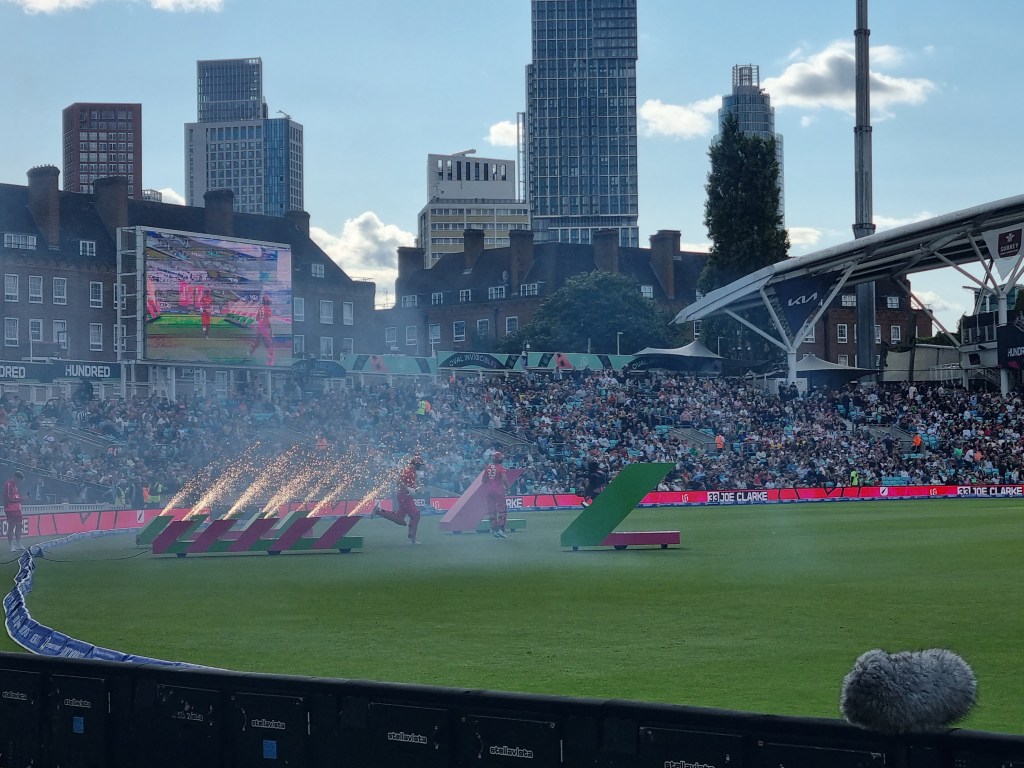
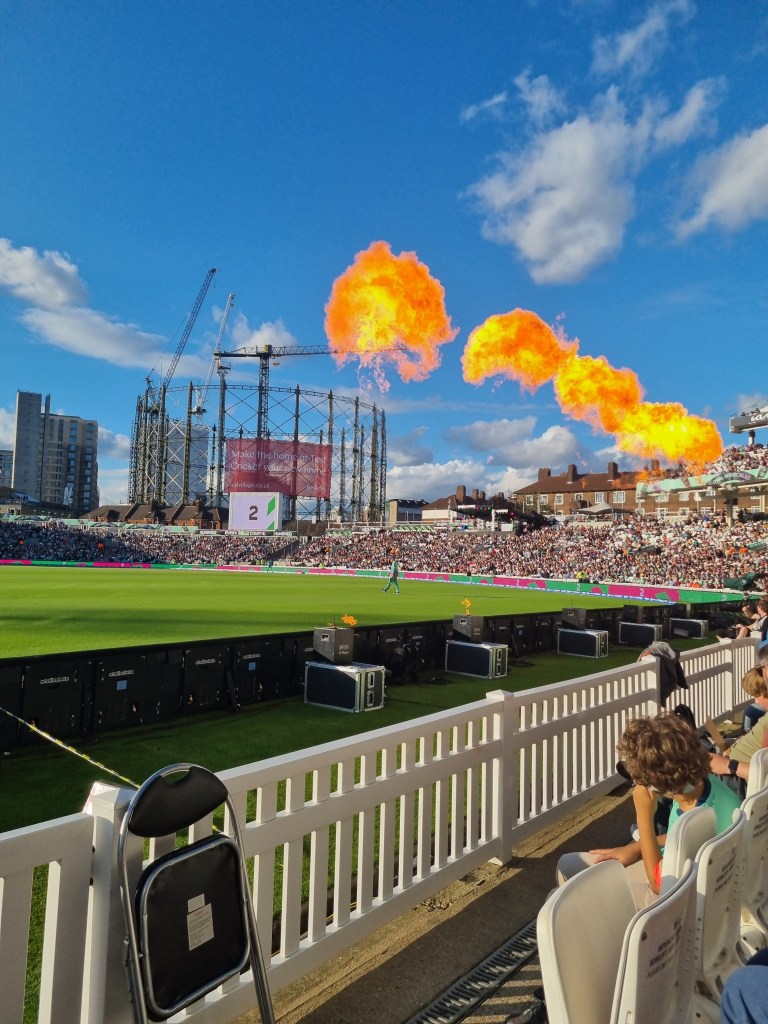
The competition has been around for 3 years now, but I have just had a bit of a Hundred bonanza, attending 3 games in three days. Sunday was the first genuinely thrilling game I have attended.

I am not ‘anti’ The Hundred. I have been to games each year, and I ‘get’ the idea. Mistakes were made, but overall the presentation is slick, and my son loves it. To be fair, my son just loves cricket – and at the end of the day, The Hundred is just that – cricket. But The Hundred has a particular appeal to him – he likes the razmataz. Despite all the special effects, the cricket has often not been that exciting. Both men’s and women’s fixtures have been played on tired pitches in the midst of very busy grounds, running at capacity. This weekend was different. Once we got past the rained off Saturday, I have attended four very good games (two double headers).

On Sunday we went down to The Oval to see the Invincibles take on Welsh Fire. Invincibles looked a bit complacement and after a dire start with the bat the women were not able to extinguish a rampant Fire. In any form of professional cricket a score of 80 will rarely win, but Marizanne Kapp provided her own flames – she is such a feisty and determined cricketer that the game was still in the balance until near the end. If some of the games I have seen had been a bit slow, I was always able to see the benefits of the Women’s Competition. I always kept an eye on the superstars like Charlotte Edwards and Sarah Taylor, but, truth be told, until 3 years ago I would have struggled to think of seven women for my Fantasy Team outside of the Internationals. That was my fault perhaps – but now my problem is narrowing it down to seven. Undoubtedly that is progress. That progress was even more evident at Old Trafford on Monday where Fi Morris took 5 wickets – the first woman to do so in the competition. What an amazing opportunity for Morris to bowl in tandem with Sophie Ecclestone, who herself took 4 wickets.

The rain once again beat us in Manchester, though the Monday game saw some sunshine.

When it comes to the Men’s Game, I did not think that such progress was needed as was needed in the Women’s Game. Perhaps that impacted my viewing experience – perhaps the men’s games were under more pressure to be exciting. On Sunday, the Men’s game was exciting, with the end result a thrilling tie that kept my son and I interested to the end – we almost missed our train at Euston. A tie is always exiting – unless you are New Zealand perhaps – but the true excitement came from the fact that, again, the London based franchise would have expected an easy stroll based on the Welsh Fire performances in Years 1 and 2. Has Mike Hussey has provided an extra level of determination or has he permitted freedom to perform? Or both? He certainly was a fantastic competitor on the field. Oval Invincibles were architects of their own downfall, until Tom Curran came along – and its good to see Tom getting some limelight again – perhaps an opportunity he would not have had but for this tournament. Back in Manchester on Sunday we saw a good game, not especially close but nothing was certain until Tom Hartley managed to hang on to a Liam Livingstone skier – the ball went up miles.

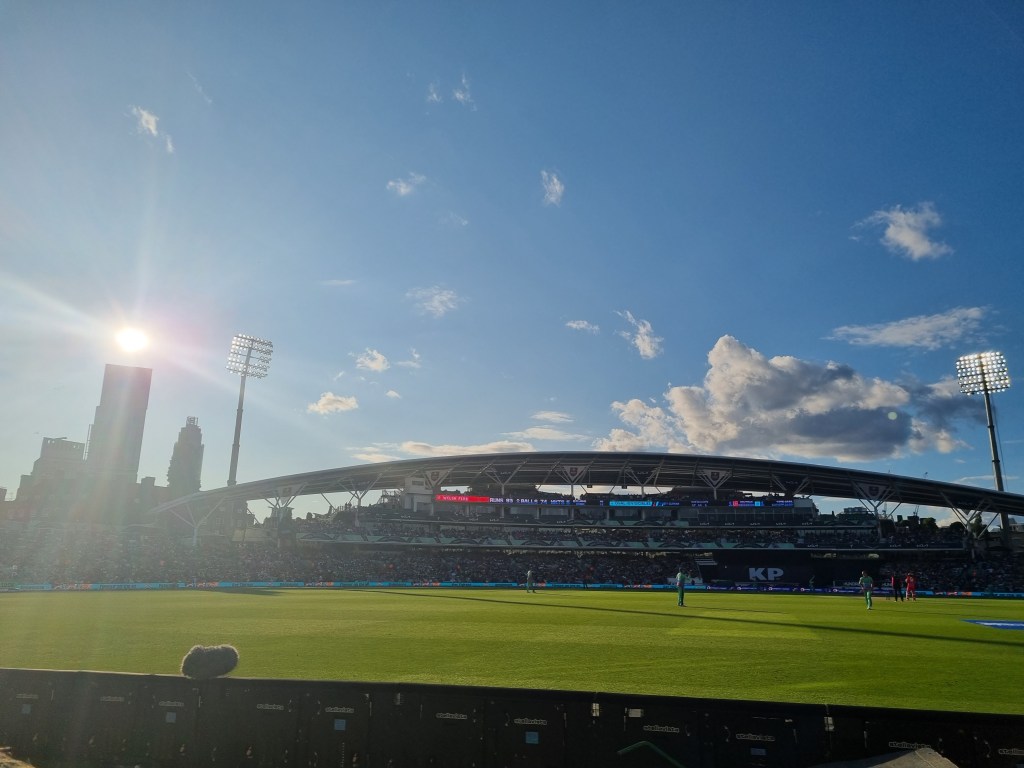
The Oval has had rain like the rest of the country, but it must be one of the best grounds in the country.

Whilst the weekend’s experience was largely very positive – we even saw some good cricket on Saturday, it was far from perfect. The Hundred is more flexible than the Test Matches, but it is still the case that the Women generally go first and, as a result, have lost more games to the weather, which is not a good look. As is the case with all cricket, the standard of fielding is incredble, but a lot of rather basic catches are dropped as well – it sometime feels like the basics get neglected in the face of the spectacular. This applies even more to the basics of One Day batting – on both days, run chases were made more difficult than they needed to be by a constant desire to play big shots and hit the sixes, when ones and twos might have been more productive. This also applied to the Manchester Originals Men when setting a target – it was very clear that it was not an easy pitch for big shots, yet they kept swinging the bat.

Away from the actual batting, bowling and fielding, a couple of other things must be said. The standard of Umpiring is a concern – this was also the case during The Ashes where a lot of poor decisions were made. This weekend, the concerns related to the Third Umpire and a lack of consistency. To my eye, Jos Buttler should never have been given Run Out (though neither should he be arguing with the on field umpire). Conversely, Tom Curran was clearly Run Out on the last ball at The Oval but escaped with a Not Out and an extra run, creating the tie. These things can always be argued up and down in different directions – but frankly, if Curran was In, Buttler was In too. When the pictures are up on the screen, it undermines the game and leaves it open to questions of integrity – certainly it might have been a different experience for the South London locals if the Fire had won by 1 Run.

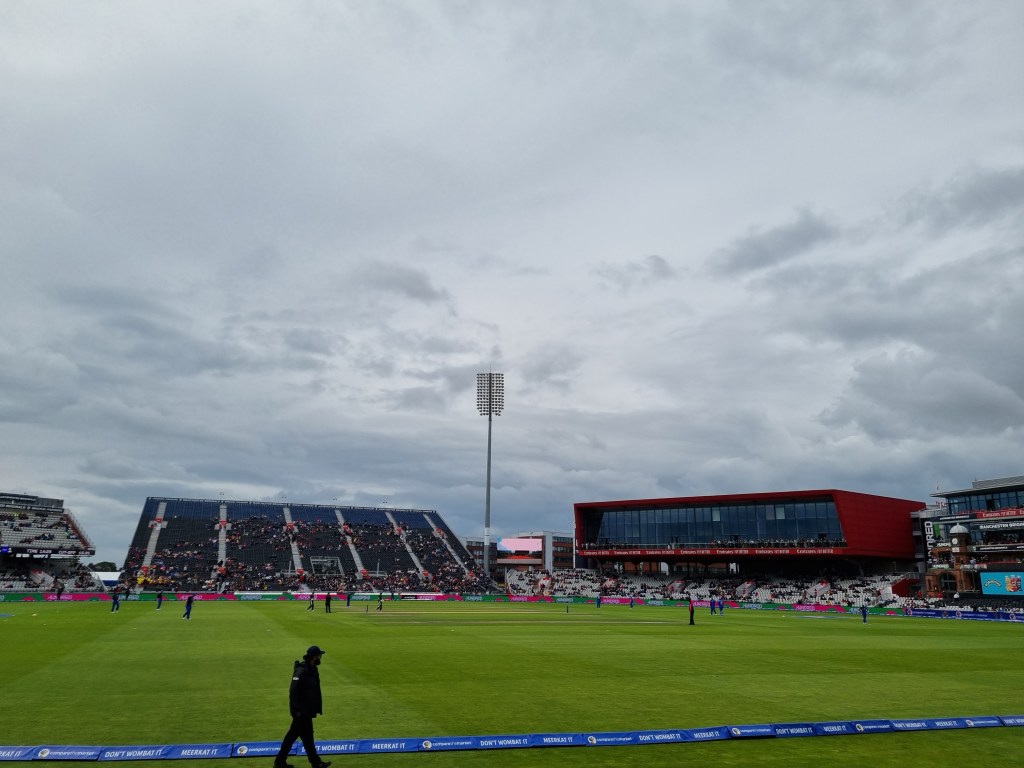
Old Trafford – a great ground, but inferior to The Oval

Secondly, I can segway into Spectator Experience. I think part of the problem with the Umpiring comes from a desire to be quick – and we do need quicker decision making. However, it means that sometimes we hear Third Umpires talking before the corresponding replays get onto the big screen which is a bit confusing, and often pointless when you have to wait for Ball Tracking anyway. The point here is about knowing what is going on – and despite massively loud music, often the announcements are not easy to hear – certainly in The Oval Pavillion. And finally, it is annoying for spectators to be told all the time to sit down – often by quite rude Surrey members – when stewards and camera staff wonder around in front of fans all the time. Generally, unless its in front of the sightboard at the relevant end, the distraction is minor, and we need everyone to be relaxed and made to feel welcome.

So, then, what about The Hundred? For all the positives, its hard to escape from the fact that English Cricket has created a bit of a mess. Introducing the tournament has created a lot of damage, and personally, I think the Investment of the Hundred could have been applied to the T20 Blast. If the Women’s Game was not quite ready for 18 counties then it could have been based around the pre-existing Women’s Franchises – but it probably is now ready for 18 counties. The problem is that removing the competition would, now, also be rather damaging.

The endgame, of course, will be results – and that will apply whether or not the Counties approve, irrespective of any residual damage. If the tournament is able to attract some top level players and if it is able to offer returns on investment, the tournament will survive. It will not compete with the IPL, of course, neither should it try to, but I am certain England can accomodate a successful major tournament.

Can we have The Hundred and the T20 Blast? I have certainly seen more exciting T20 games than Hundred games. But it will be money and player power that wins. If both tournaments attract the players and enough money, they will survive. Its up to the counties to make sure it does – they have lots of advantages for sure – after all, The Hundred is not played anywhere else. Counties will need to satisfy both men and women players though. As for the quality of the game? Both tournaments can improve, and must do so. It is going to be survival of the fittest, rather than what the ECB decides.

Old Trafford: Doom

A disappointing end. Australia had no right to draw a game in which they were thrashed. However, 2-1 up is a fair reflection. England were careless in Birmingham and are now paying for it.

Trouble for Test Match Cricket

I have a great deal of respect for the genuinely neutral cricket writer or broadcaster. Not many remain, but it is hard not to get overly swept away by negativity on days like yesterday and today. However, as a Day 4 spectator, I saw a few things that seriously question the viability of the format. I had my son with me, and I really wanted him to get ‘The Ashes’ bug like I did in 1993 and 1997. Though I was a tad older, so he still has time, I was full of frustration.

Weather

As for the weather itself, I am not sure that Old Trafford could have done too much more than they did. The covers look quite limited, but the ground does drain brilliantly. Let’s face it – given the Manchester weather – it would have to drain brilliantly. As a local, it does upset me that the bad weather always comes during Test Matches – if Manchester hosted the first game of the series it would not have been weather impacted as much as Birmingham was. However, it has to be said that the Old Trafford test match in 2013 was rained off, allowing England to win the Ashes in a lost cause, in a similar way to Australia here. In 2005 weather stopped England winning, and in 2019, the day 1 weather was fowl.

What needs to be looked at is more flexability and adaptation, allowing the maximum game time. And someone has to remember that 20,000 people are sitting in the ground, watching. Those tickets are not cheap.

Over Rate and Start and End times

When interviewed this morning, Joe Root suggested some sensible ideas around start and finish times. I agree with him. Test Match Cricket needs to start at 1000 if the weather allows it. The argument about peak time travel is outdated now. Weather permitting, cricket needs to go on longer to allow all the overs to be bowled. This would particularly apply in circumstances such as this weekend, where the forecast was so poor. However, where I disagree with Root is around over rates – the players need to make an effort here. The Over Rate on Day 4 was so poor that it was just dull to watch. England caught up, of course, because the spinners had to bowl. And I am winding up to that. But some things are so frustrating. At one point, we had to wait between balls every time while short leg came in with helmet for one batter, then went out for the other. It was painful – and applies to all formats of the game.

The ground environment

I love Old Traffod. A T20 at Old Trafford is a riot of fun. For the test match, it was all ‘serious’, trying to be ‘prim and proper’. The family facilities were poor and they tried to stop you moving between overs. I appreciate its more serious, but if the lighter environment creatws successful T20s, Test Matches need to take it on, rather than fight against it. I want Test Matches to live on. I loved it growing up, when it was more serious, but not many of my friends did. Test Cricket needs to help me to engage my sons.

Umpiring Standards, Lights, Floodlights, Safety and CONSISTENCY

In this test match, the umpiring was diabolical. LBWs that were plumb were missed, and Umpires Call ones were being given out. Obvious edges were missed. And then, we come to the light.

Test match cricket just has to stop this situation where the light is deemed poor, but gigantic floodlights are shining everywhere. It is utterly mad and looks terrible. If the floodlights work in One Day cricket, they work in test matches – and if the ball has to change, it has to change. If it is safe in a T20, it is safe in a test match. The site of an umpire in sunglasses suddenly deciding its too dark for Mark Wood to bowl when it had been fine an hour earlier is one of the most ridiculous things you will ever see. And try explaining it to a 7 year old, not that anybody bothered to explain it to the crowd (probably the announcer could not believe how ridiculous it was).

I am not sure how the process works – is a light meter reading taken every time an innings or day starts? However, I was at the ground, and the change in light between the start of the session and the end was simply so minor it was totally irrelevent. The light was so bad that two massive sixes were hit in the next overs off the spinners (note – sarcasm!). It makes no sense. England had to bat in awful weather at Edgbaston. Australia should have faced Wood before tea on Saturday.

The point here is consistency. If we have a genuine safety issue here, it applied in Birmingham in England’s second innings, and it applied all through Day 4. It did not suddenly appear. Test cricket has been played in much worse light. Test match cricket will not survive while the decisions taken by officials are so unreliable and weak. It applies to LBWs, light decisions, no ball calls…indeed, to every decision the officials take.

The new players are not coming through

With the exception of one or two, both teams was very similar to the ones in 2019. The England bowling attack was one of the oldest ever for England, and the 3 Australian fast bowlers were the same as in 2019.

Who are the players that we will see in the next series, and will they be fitter? One is beginning to wonder who will play the test matches – Root and Jonny Bairstow might be around in 2025, but Ben Stokes Jimmy Anderson, Chris Woakes, Mark Wood, Moeen Ali will not be. Despite the Crawley heroics, only Harry Brook looks truely at home in test match cricket of the younger players for England (the likes of Ben Duckett and Ollie Pope).

So what can be done?

England have shown that Test Matches can be played in a different way, a way that is a spectacle, and some other teams are starting to copy it. Australia have been snobbish about Baz-Ball, but they are lucky that the slightly dull style of cricket they play has held out for them. It would not have done so but for the rain.

The ICC has to tackle some of the issues raised above that swiftly reduses the game to a farce. And, of course, the Schedules need to be realistic.

What about the cricket we did see?

It was great from England, awful from Australia except for Marnus Labuschagne. He played a classy knock. Wood was brilliant (when the umpires let him be), Woakes bowled well, though Broad and Anderson were not effective.

Tactics

England played well and, as David Lloyd once said, ‘we bl**dy murdered them’. England were right to bat on, or else they might have had to bat again. I had no issue with the Birmingham declaration, but England threw that game away with bad catching and bad second innings tactics. As for Lords, Australia played well – I think the bouncers were a good tactic, the critics never suggested an alternative, and it took Joe Root to come up with the answer as he did in Manchester.

Wonderful Woakes

I wonder how much of the decision-making comes from Chris Woakes being around? A calm, sensible head, joining in with the madness but not getting carried away with it. It seems just what England neeed in the dressing room.

We can not be sure about that, but we can see that they needed him on the field. He has taken wickets and should have had one more, but for some reason, his early wicket on day 2 was given a no-ball. I have already made my views clear on the umpires – his foot was behind the line, so I do not know why it was given as a no ball, but anyway, he still got 5 wickets, it just took 17 minutes longer than it should have. Not only has Woakes taken important wickets, he stuck around to hit the winning runs in Leeds. Then he found time before the 4th test match to pop over to Stockport and spend some time with the Stockport Georgians Disabilities Team (my local club). What a great guy!

Zak, Jonny and Joe

Crawley had his moment at last. He has had a really good series but needed that big score. He played like a man possessed – if he can just be a little more selective, he will play for few more of these innings.

Bairstow is now looking match fit – at Edgbaston, he was not. He gave an interview yesterday where he basically said as much – he was never going to be the right choice as wicket-keeper at the start of the summer, and he will not be the right choice in India. His batting has never been in doubt since the start of last year.

Root continues to inspire. As soon as he arrived at the crease on day 2, I spotted his new bat lift and I knew that he had cracked the bouncer theory. Australia should have ‘yorked’ him first ball – that would have been interesting.

Back to London

So England must go to The Oval and win. A 3-1 loss is a BazBall failure. 2-2 is a fair result for two matched teams. I hope the Aussies are not too smug – they have a few issues too. Its been a great series. But I do feel it is papering over the cracks.

It pays to stay in

The great thing about cricket is that every time you think you have the answer, it evolves. So it is that the premise of this article was solid last week, but maybe not today!

After the second One Day International, I was ready to give Heather Knight the plaudits. In the T20 series at The Oval, Ellyse Perry nearly dragged Australia over the line singlehandedly with a load of sixes at the end. In Bristol, it was Knight who did get England over the line. That Bristol performance contrasted with what we see so often these days when teams over-attack and lose vital wickets – particularly when chasing.

Knight kept things simple and made sure she was around at the end. Knight did not try to ‘hog’ the strike, and so we were spared the scene that has blighted the Men’s Ashes this year – where the bowling team focus on getting the tailenders out, allowing Ben Stokes or Travis Head to keep hitting the sixes (Travis Head suggestion – try hitting his stumps). It worked well for Knight when Kate Cross was able to get a few boundaries.

Then Nat Sciver-Brunt tried to do the same thing and it did not work. It failed in two ways for Sciver-Brunt on Sunday. Firstly, she was not quite at her best – at her best she would have got a couple more boundaries or sixes. She was still brilliant by the way – it is a measure of how good she is. The second issue was that, whilst Sarah Glenn stuck around, she did not quite score enough runs. I would have sent Cross out yesterday. However, whilst one can say that England did not win the game on Sunday, the fact they were even in with a chance owed to the fact that Sciver-Brunt was in. Similarly, Knight needed to be in at the end for England to win in Bristol.

I saw something similar last week in the County Championship when Lancashire lost in Blackpool. Lancashire tried to play some ‘BazBall’ and should be applauded for attempting to chase a massive total. They needed to switch into defensive mode a bit sooner, and they ended up being bowled out. However, they nearly got the draw because Rob Jones batted almost till the end.

Within the last week, I have seen at least 3 limited overs games lost where a team failed to chase a total – once in the T20 Quarter-Final at Old Trafford when Lancashire slipped up, and twice yesterday when Surrey and Essex failed to chase targets. All three probably should have been won by the team chasing. In the QF, Jos Buttler was in and needed to stay in. In the Semi-Final, Surrey went too aggressive. In the final, Paul Walter failed to take advantage of some luck, going for a big slog and getting bowled.

This is not about ‘one size fits all’. Different games of cricket will need different tactics. But generally, I think it is true that batters need to put a high price on getting out. In the Men’s Ashes, England have been careless with wickets and it has cost them. I do not accept that England would be 3-0 up – the Aussies are too determined for that. But I think it probably would be 2-1 to England but for some poor batting choices made by all of Zak Crawley, Ollie Pope, Joe Root, Harry Brook, Ben Stokes and Jonny Bairstow. The point is not that they got out, but that they were set and could have scored runs quickly – but they got out.

England Men must look at this. I am all for positive batting and support ‘BazBall’. England have competed in this series in a way they did not in the previous series when they tried to play ‘proper cricket’ .However, they must remember that BazBall cannot be played in the dressing room. Once you are out, you do not score runs, and your style of play counts for nothing. Old Trafford will be tricky because of the weather, but the pitch will be a good pitch. Runs will be on offer for those who play well. Steve Smith will want runs. England need them too.

Lords digest

The second test match created lots of talking points and an amazing spectrum of dull cricket to extremely exciting cricket. Here is my view of the key points.

Its just not BazBall

Despite all the hype, England are not playing the cricket they played last year. They need to look closely at what worked last year. They have lost the sharpness and the excitement of last year in the field, the variety with the ball and the common sense with the bat. One of the most memorable moments of last year’s home season for England was the way Joe Root and Jonny Bairstow battled and ‘dug in’ against India before taking the attack when chasing the target in Birmingham. That is missing from 2023.

Cosy and Comfortable

For some of the players, it has got too cosy. Whilst we do not want to go back to 30 players a series (see 1988 and 89), the players need to know that if they fail, they can be dropped. Equally, county players need to know they can get into the team. It does not seem to be the case at the moment.

Bowling: the true difference between the teams

England’s batting lacks variety, and they miss having Ben Foakes coming in down the order to play differently if needed. Lack of variety is an even bigger problem when bowling. At Lords, we failed to pick a spinner, and we had 5 right arm bowlers, most of whom were unable to get past 80mph. That collection of ‘samey’ bowlers were poor on Day 1 – and that is where the Second Test Match was lost.

Equally, Australia won the game on Day 4 with brilliant bowling to get rid of Root and Harry Brook. England will have to shake up the bowling quickly – Mark Wood has to join Josh Tongue and Stuart Broad. Ollie Robinson needs to go away and find that little bit of ‘nip’ that he has lost. And, sadly, it has been one too far for James Anderson.

I am not convinced by Scott Boland or Cameron Green, but Josh Hazelwood, Mitchell Starc and Pat Cummins are all brilliant. Baz Ball or not, it is bowlers that win test matches.

Steve Smith (again)

I mean, what can one say, other than that England needs to get Steve Smith out. One more big Smith score and it is all over. Smith looks angry but driven. He is not a nice batter to watch. But he is brilliant.

My biggest frustration is that England falls into a trap of bowling where he wants them to. It has been happening for years. They see him walk across so they bowl at his legs. Guess what? It’s 4 to midwicket. They see his footwork and bowl wide, and it rockets past point for 4. Like that South African nemesis of the same name, Graeme Smith, England needs to bowl the same way at Smith as to everyone else. When bouncer theory works, use it, but otherwise, top of off stump, please.

Bodyline 2023

England were vilified for getting out to bouncers. They want to lose, said Michael Vaughan, who seems determined to see England lose. The criticism was widespread but went too far – the fact is that nobody on either team had an answer on that Lords pitch to the bouncer.

We will see if it is just that modern players can not deal with it or if the pitch was awkward because we will see a lot more in the final three games.

The Lyon roars

I have not always been a fan of Nathan Lyon but in this series, he has come over well. I was sad to see him out of the series injured. He still made a remarkable contribution with the bat – on one leg. That hopped run will live long in the memory and deserves the greatest respect. Lyon allowed 15 runs to be added by batting as he did. That would have got England’s target into the 20s – which always changes things.

Endless Extras

Before we talk about the controversial moments, let’s deal with the careless ones. England lost by 43 runs but conceded 74 extras. If we dismiss the byes, it is still 25 no-balls and wides. And of course, we had the standard Ben Stokes wicket off no-ball, though he made up for it. A couple of dropped catches, and suddenly, you have found those 43 runs.

Sack the bowling coach, get some practice in. For crying out loud, STOP THE NO BALLS.

Silly Starc

I have no time for this one. Starc caught the ball and then dragged it along the ground with his fingers over the ball. Of course, it’s not out. I cannot understand why anyone would think it was out.

Of course, maybe in the past, those were given. That does not make it right to give it now. That being said, we need consistency, which has been lacking for years when it comes to catches.

Bonkers Bairstow

I do not have much time for the Jonny Bairstow controversy either, but we will spend a bit more time on this. Bairstow was correctly given out after he strolled out of his crease. It really should not be more controversial than that. In the same way as the so-called Mankad, the whole mess can easily be stopped if batters just stay in the crease. He was sloppy and dozy. He deserved to be out and should have walked off.

These are professional cricketers who cannot afford to throw games away. To expect them not to appeal or to withdraw the appeal is not fair or realistic. Captains like Paul Collingwood, and even Brendan McCullum, made the decision to appeal and afterwards wished they had not. But afterwards is pointless – the game is lost by then.

But what about ‘The Spirit of Cricket’?

It seems to me that the so-called ‘Spirit of Cricket’ does nothing to create good spirit. It creates controversy and anger. It creates self-righteousness. It creates conflict and aggression. It gets MCC members so angry that they have to be suspended.

All the conflict around ‘Mankads’ would not exist but for ‘The Sprit of Cricket’. The problem is that it relies too much on individual interpretation. That interpretation often comes in high-pressure moments when vast numbers of people are watching. Often, many of those people watching want to see a particular team win. They are watching cricket, not listening to The Moral Maze. The idea that a Captain takes a choice that risks a winning position is hard to accept. We will have to see if Ben Stokes lives up to his rhetoric – cricket is such a funny beast that he is sure to find himself on the other side of controversy at some point in the summer.

As far as I can tell, the Spirit of Cricket does more harm than good. Here is a crazy idea. If we do not like the rules of a game – change them. Let’s make the rules around Run Outs at the bowler’s end clear. Let’s not allow run-outs unless the batter is intending to run. Change the rules. Don’t expect Captains to interpret the nefarious ‘Sprit of Cricket’ and all make the ‘right’ decision. Because I promise you – they won’t. Under pressure, with people watching, they will make the decision most likely to win the game.

Scintillating Stokes

As for Stokes the batter, we have seen it before. He has the ability to see through the impossible that not many people have. I have no words that have not already been uttered. A captain can do little in that situation. In the end, Stokes could not do it. Imagine if we had not conceded those extras though.

Saying all of that, Stokes did need runs. He really is not going to be a bowler for much longer and will have to convert himself back to that batter at 5 who can play in different ways at different times. To be honest, it is debatable how long he will be around for at all. We must treasure it while we can.

Design a site like this with WordPress.com
Get started