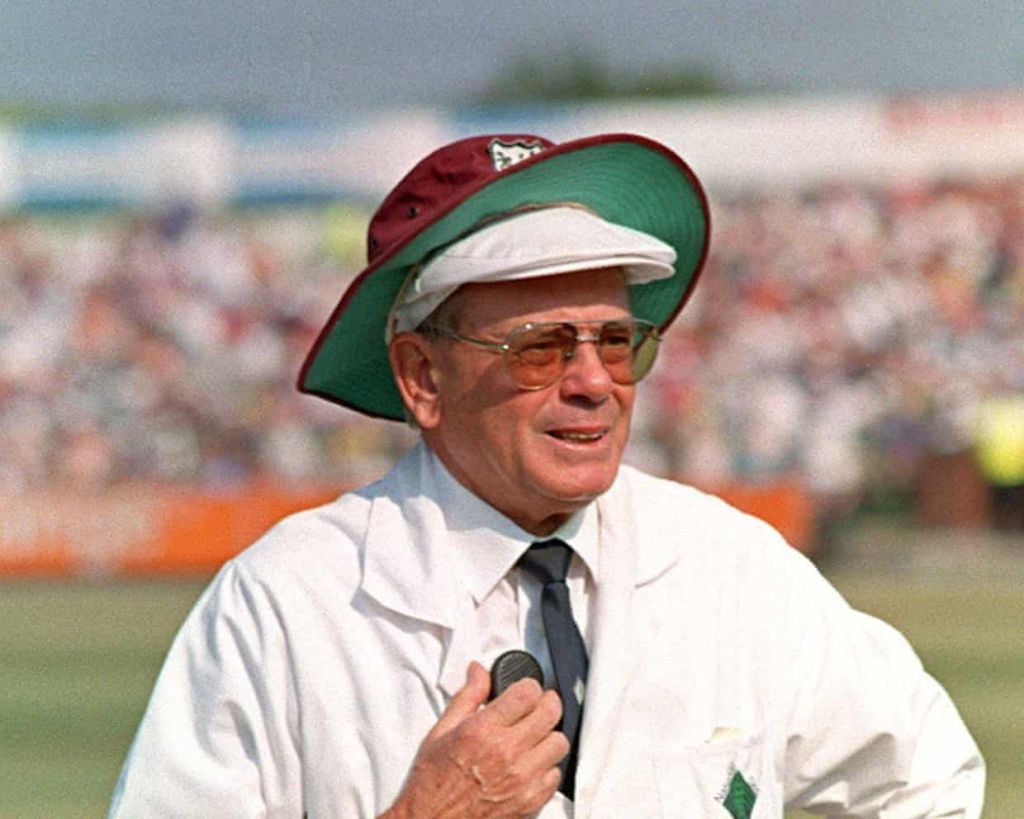
Umpire Bird

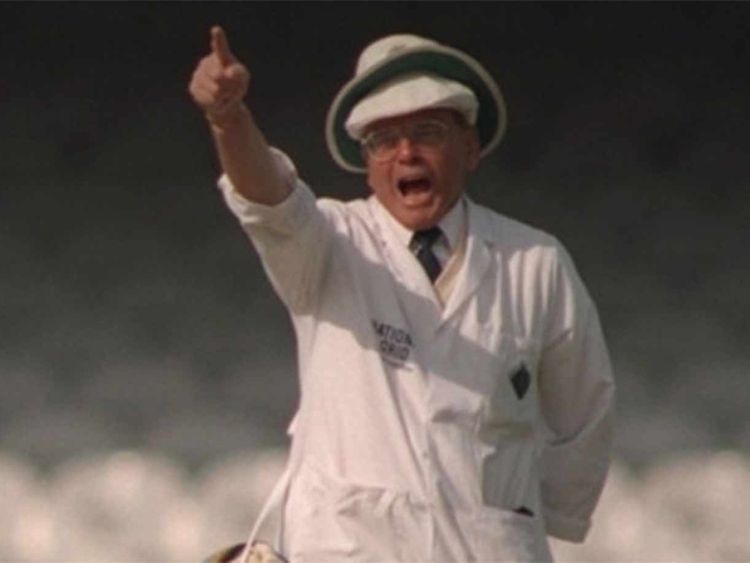
I had to say something about Harold Dennis Bird. Not that I would ever have called him that. As far as I can tell, Richie Benaud was the only person who called him Harold Bird. To most of us cricket fans, he was always ‘Dickie’ Bird, my favourite umpire of all time, with David Shepherd in second place.

Picture from https://www.yorkshire.com/headingley/inspiration/sport/dickie-bird-yorkshire-cricket-umpire-legacy?srsltid=AfmBOoqYYL2qQP0P5wuz8Y4AYMlo27JJfxs3wfGcRKIMxEqzGHuu559Y

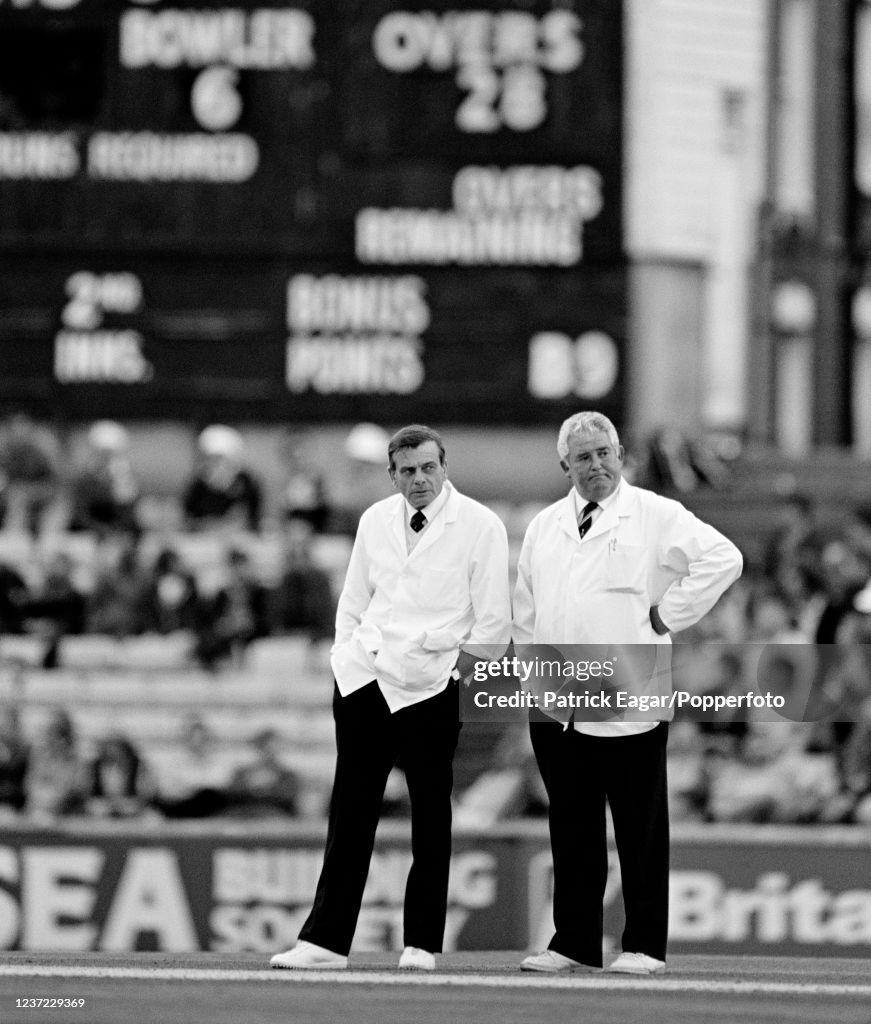
It is fitting that fitting that I linked Bird and Benaud. A huge memory of my childhood was watching cricket on the BBC. In my head, I can still hear Benaud introducing the umpires. “The umpires today are Harold Bird and David Shepherd.” It might have been someone like Ken and Roy Palmer, David Constant, Nigel Plewes, Barrie Meyer, Barry Dudleston, John Holder…..and I will have missed a few greats. But, for me, Dickie was the greatest of all.

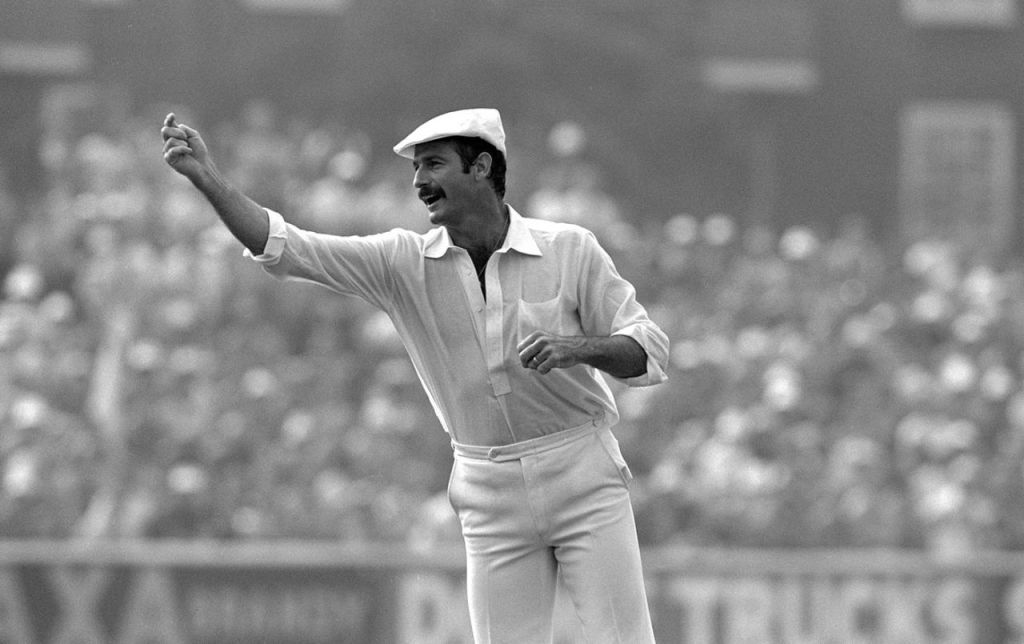
My two favourites. We loved them because when they needed to be serious, they were. Picture from https://www.gettyimages.co.uk/detail/news-photo/umpires-dickie-bird-and-david-shepherd-look-back-towards-news-photo/1237229369

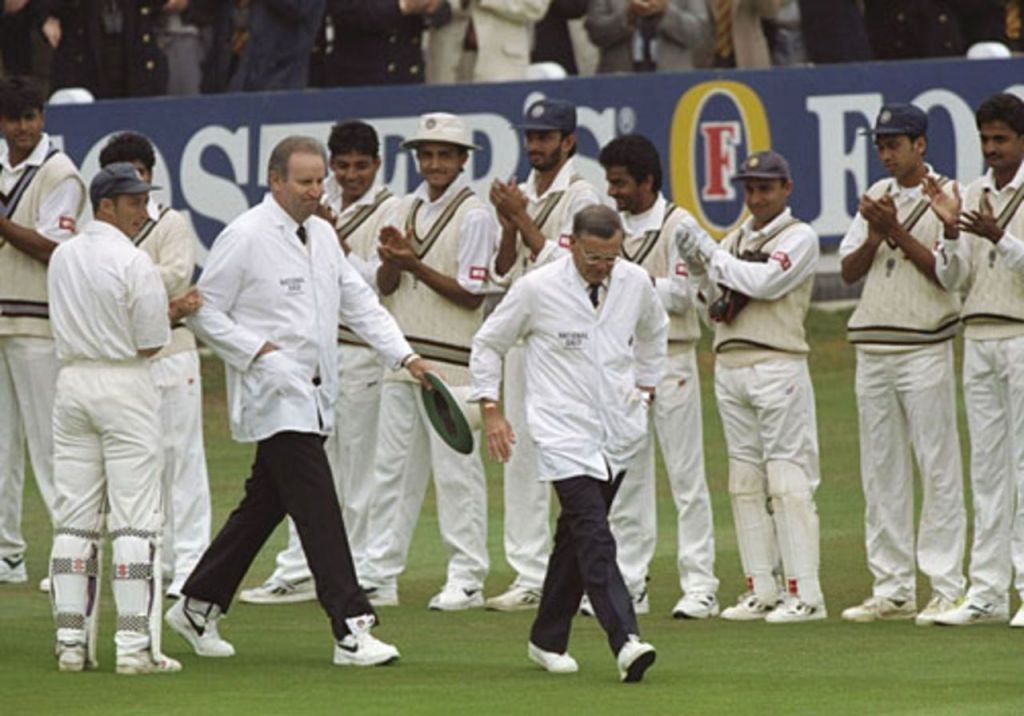
You did not have to watch Dickie at work for long in order to see that he was quite emotional, which I gather hindered his playing career. As an umpire, it became a strength, helping him to get alongside players. If tempted to think his emotions impacted his judgement, you only had to watch his last test match at Lords in 1996. Mike Atherton arranged for the players to form a guard of honour, which left Dickie reaching for the tissues. However, he had no trouble giving Atherton out plumb LBW in the first over. So much about Bird is encapsulated in that one game. Full of humility and emotion one minute, sending England’s captain to the pavilion the next. Yes, Dickie was often laughing, occasionally being a bit silly – but the players knew he could get serious as and when it was needed. Where a word with a player was needed – just ask Merve Hughes, he would have it, but mostly, he would try and get alongside the players. That was how he avoided conflict. And why he was so respected.

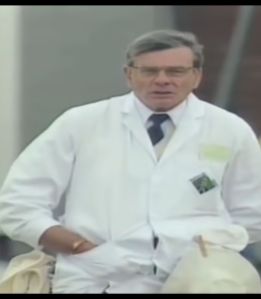
Dickie Bird. You were never in doubt when he gave someone out. Picture from https://i-yorkshire.com/yorkshire-folk-part-6-dickie-bird/

Now then, let’s get down to the biggest change in sport since those halycon days of the 1980s. Television replays. We had them, but they were not of the quality they are now. As a result, we can never prove that the ‘old’ umpires were as good as we thought. Modern hawk-eye analysis suggests that Umpire Ray Julian was right and a lot more LBWs ought to have been given in the past. But what cricketers looked for – and still do – is consistency. Unlike Julian, ex-players would say that Dickie was a not-outer. Bowlers found that frustrating but and batters knew it was highly likely to be extremely plumb when Dickie put the finger up. Some say that the implementation of the Decision Review System has weakened umpires, but I disagree. I think what has weakened umpires is a consistent failure to intervene when player behaviour or over rates are not up to scratch. That is nothing to do with technology, which I think Bird would have embraced – after all, he was one of the first international umpires to call for the ‘TV umpire’ to make a run-out decision. Even technology cannot ensure consistency – just ask Snicko. The umpires that have been consistent have been the most popular, and that is why Denis Lillee once called Bird ‘the best’.

As the 1990s wore on, neutral umpires were introduced. I think we got it right in 1990s when we had one home umpire and one neutral umpire, and I think that policy could be solidified now as we always have 3 umpires and we have DRS. Any suggestion of bias would be detected now – though I do think 1 neutral umpire is still needed. It seems a great shame that English umpires never get to umpire at home – which drove Peter Willy off the international panel due to the level of travel required for neutral umpires. Except for the period during and immediately following Covid, never again would you see two English umpires in a test match. So it was that the 90s saw off the Bird and Shepherd combination in test matches. The positive was that they got to work with international colleagues, both home and abroad, for a few more years. It gave ‘Dickie’ the chance to umpire in Australia and the West Indies, amongst other places. Given Dickie’s reluctance to give an LBW, it is a brilliant piece of irony that Dickie stood in a record breaking game in the West Indies for the number of LBWs given.

I could not find this picture, so I cut it off a YouTube video of the Gatting destroyer in 1993.

Bird memories? Crazy things seemed to happen when Dickie was involved. Unlike ‘Shep’, Dickie did not hop when the score was 111, but he did once end up with Allan Lamb’s mobile phone in his pocket. I used to love it when quick singles were taken, and the umpire had to run around to be able to see the run-out line and the stumps. Generally, ‘Dickie’ got this right, but every so often, Bird would not quite be quick enough and would obstruct a throw. A couple of times, Bird also got in the way of Graham Gooch streight drives. Dickie did the Lords test match in 1990 when Gooch made 333 – he seemed to spend the entire game signalling four. The Oval pigeons always created hilarity. And, memorably, he was standing when Shane Warne destroyed Mike Gatting at Old Trafford in 1993. I also attended that game at Old Trafford in 1995 when play was delayed due to sunlight reflecting off B&Q. The Lancashire members gave Bird a hard time. If it is not rain, it is sunshine.

The last test match. Picture fromhttps://www.espncricinfo.com/photo/an-emotional-dickie-bird-starts-his-final-test-172740

As Dickie got older, the tall-stories got more and more extraorinary. But it was such a delight last summer to hear ‘Dickie’ re-tell that story about losing his cap in the 1975 World Cup final, which he said was the highlight of his career. Jonathan Agnew had to help Dickie along a bit – and he handled that interview so well.  Dickie said that his cap got taken off his head by spectator in the madness at the end of that World cup Final, but it turned up a few years later on the head of a London bus conductor. As a child, I always chose to believe that story. I really do hope it is true.

I can not be certain, but I think I was at this game. Thanks Dickie – you inspired a young cricket lover. Picture from https://www.theguardian.com/sport/2025/sep/23/share-your-tributes-and-memories-of-dickie-bird

The latest Pomni-shambles

What can we say about The Ashes that has not been said before? We are not allowed to say England are arrogant – so shall I follow Ben Stokes’ suggestion and just call them rubbish.

The problem I have with Stokes’ comments regarding accusations of arrogance is that the England team is behaving in a really arrogant way. That response of ‘call us rubbish but arrogant is going too far’ is…..just incredibly arrogant. The whole point is that people are not calling England rubbish. They are looking at obviously talented players – and wondering why that talent is not being used. They are seeing the same mistakes repeated and are becoming very annoyed with the consistent reply from Stokes and the team. That response, consistently, says ‘we know better than you how we need to prepare, even though we are losing’.

Well, it would seem that England is in all sorts of trouble in Brisbane, and I fully expect them to have lost heavily, by an innings, before I wake up tomorrow. But they have 3 choices.

  • Prove themselves right. They can only do that by winning 3 consecutive test matches. They would love to prove me wrong of course – Stokes to score 300 tomorrow backed up by Will Jacks scoring 150 anybody? More realistically, they have to make it work in Adelaide.
  • Own up. Its too late to change for this series, but perhaps if they turned around and said ‘sorry – we got this wrong’, they might be able to come out of the bunker of arrogance, and have some honest conversations.
  • Keep making the same, sloppy, stupid decision making – and loose 5-0. If they choose this option, its what they deserve.

Why is this so bad?

Lots of reasons.

This is as poor as anything we ever saw in the 1990s, which was a decade of doom for England cricket teams. The Perth test match in the 1994/5 Ashes series runs it close – I can not begin to remember how many catches went down in that game, but they had played well in the 2 prior games and had won the 4th test match in Adelaide. And this was against a good Australian side.

As Stuart Broad has said, this Australian team is the worst Australian cricket team since 2010. I go further than Broad – they are worse than the 2010 team. Fortunately for those Aussies, they have come up against a side with talent, but lacking in planning, application, fitness and honesty. England has never had such a good opportunity. But they have not been able to take the chance.

But the worst thing of all, something Australian media will want to ignore, is the quality of the cricket. Loose shots, dropped catches and average to terrible bowling. Australia have been average, England have been diabolocial. For The Ashes to continue to mean something, it has to get better.

Ashes Day 3: Arrogant

My expectation was that I would be writing about a humbling defeat for England today, but they were not even able to get the game into Day 3. But I can not say I am very impressed with the attitude of either team.

Boof and Smudge

I don’t think we should have to put up with arrogance just because a team wins. I could not believe what I was reading when I saw Darren Lehmann moaning about the abuse that innocent, poor old Steve Smith has to cop from England fans. Smith, with the superior intellect to Monty Panesar.

Lehaman says that England fans – who he rather rudely referred to as ‘pork chops’ – should be better than that. Correct me if I am wrong, but it was not England who got caught with the sandpaper. The Aussies like to talk about Mike Atherton in 1994 – perhaps with some justification, but that was very different to the pre-planned nature of the sandpaper incident, and by the way, we all know that other team members knew what was going on, but they just did not get caught.

https://www.bbc.co.uk/sport/cricket/articles/c1w9n3q9evdo

Let’s be clear about this. England fans respect Smith’s ability – even if he is a challenging batter to watch – and are willing to accept that Smith, along with David Warner and Cameron Bancroft, served a punishment – even if it was a punishment that did not cause any of those players to miss an Ashes or World Cup.

However, we do not just turn round and pretend that the whole thing never occurred – any more than the Aussies like to point out English misdemenours. Smith and Lehmann should show some humility and stop looking for point scoring opportunities arising from the attrocious behaviour that went on under their leadership.

From our side of the world, it looked like the whole of Australia was full of anger after ‘sandpaper-gate’. The Australian team has often liked to tell everybody else where the line of fair-play lies. But it seems they stop worrying about such things when they win games of cricket.

England

This is not a balanced article. No. Because if the Aussies deserve some criticism for their attempt to pretend the sandpaper thing never happened, the English cricketers deserve to be roundly attacked for their attitude. They take arrogance to a new level.

Consider Zac Crawley, the undroppable opener. Here is a batter who has only played 1 game since September – and that was England’s warm up. No sh*t sherlock, but he looks out of form. Even Joe Root, rarely arrogant, strolled into the country just a couple of weeks ago – he looks out of form. Of course he does. Yet even after a terrible batting display and bowlers that looked tired after a very short first innings, this England team still won’t play warm-up games.

I am with Sir Geoffrey Boycott this time – it is a joke. And I am with Michael Vaughan – who wonders if the England fans will turn on this England team.

This England team keeps making the same mistakes. Even within a game, they make daft mistakes. Allow me to adapt a well-known phrase. To lose one wicket on the cover drive is unfortunate, but to lose 2 looks like carelessness. To lose 3 wickets on cover drives in 15 minutes?

That is arrogant and closed-minded. Frankly, I would be annoyed with my Stockport Georgians Under 11s for playing like they did – yet they still make out that they know what they are doing. Time to get into the real world.

Ashes: Day 2 16:00: Not a good test match but Travis can bat

England lost at Perth. They were always going to, they never had enough runs and batted like idiots. Honestly, we could leave it at that. The wickets of Ollie Pope, Harry Brook and Joe Root were plain pathetic, and all of them should be ashamed of themselves. The bowlers are not free of all blame either – they very kindly fed Travis Head’s strengths.

However, I do think we need question some of the media statements around this game. Anyone who says this is one of England’s worst ever defeats has missed a few defeats in Austrailia over the years. I always thought the games would be like they were today – England would not be too far out of it, but would have a few disasterous half hours that they often get away with in 3 match series, but in 5 test match series will open up a chasm.

Travis Head

I have to be honest, I have never rated Head, and I still don’t. He does not have a good technique. What he does manage to do is get bowlers to bowl to his strengths. He looks ungainly against short balls, so bowlers feed him short balls, which he keeps belting for 6. He walks across his stumps so bowlers go for the LBW – and he clips the ball away for 4. They see his static footwork and bowl outside off stump, and he crashes it away. It is just so predictable.

Head reminds me of Graeme Smith of South Africa and Steve Smith – though these are a vastly better batters. But these batters trick the bowlers into feeding strengths.

Here is a mad idea. Bowl to Head the same way you bowl to anybody else – just outside off stump on a full lenth. I think he is more likely to edge behind – like most batters – than to top edge a hook.

But saying all of that, Head was brilliant today, and it was a masterstroke to open with him. Undoubtedly, the Australians were better at tactics today than Ben Stokes, who was not at the races with bat or ball. He can not be at his best every day.

Can things improve?

I doubt that things will improve. But it is not impossible. I think we could ask questions about selection and also the toss. But whatever happens, England needs to score more runs – 300 must be the minimum.

It means hard practice – yes, they do need practice games – and some flexability. Not a change in approach – Head showed us that England’s approach is right. However, if a shot is dangerous and causing lots of wickets to fall, then don’t play that shot, or at least give yourself some balls to get in.

Indeed, when England got tentative, they also lost wickets. Play to your strengths – but don’t be reckless.

Was it a good test match?

No. Not in any way, shape or form. Test matches should last 4.5 days on average. When we have games over in 2 days – it means sides are not batting properly.

We know that 5 day test matches can be exciting. Yes, this game was unpredictable, but not high quality.

On this evidence, test matches will soon be 3 day slog fests soon. But it does not need to be this way – we saw how good the games were in the English home summer when they went into days 4 and 5.

Give me Steve Waugh’s Australians or Andrew Strauss’ England any day – and both of those teams would batter the current day teams.

Ashes Day 2 07:00: Can anybody bat?

I looked at my phone, and it was 65/2. Let’s watch a bit of ‘BazBall’ I said to myself – and by the time I got down the stairs, it was 76/4. A moment later, Joe Root chucked it away with a loose drive, and it was 76/5. While I had my first cup of tea of the day, wrapping myself in blankets and scrabling to get the heating on, I wondered about the quality of batting in this game.

Root’s shot did not help, and I considered going back up to bed. He does not look himself yet – perhaps all the talk about Root’s record down under is having an impact. He has 4 test matches left to show his class,  and he just needs to remember that while his record in Ausralia is not too bad – better than Graham Gooch’s. But his shot today was poor, and I quickly saw that his was the third loose off drive in 15 minutes after Ollie Pope and Harry Brook.

Don’t get me wrong, we have seen some great bowling, and sometimes it is the balls between the wickets that is the difference that leads to the poor shots later. But for me, its been poor shots from Zac Crawley, Pope (twice), Jamie Smith, Brydon Carse (twice), Mark Wood, Travis Head, Cameron Green…..and I am pretty sure I have missed some.

At the other end of the scale – Root (first time), Stokes (second time), Jake Weatherald, Steve Smith and Usman Khwaja got good balls.

Somewhere in the middle – I have some sympathy for Brook in the first innings and Jamie Smith in the second – both done on the pull shot when they did not quite go for it. For those two, the lesson is clear – go for a full-on pull/hook or leave the ball alone – do not be half-hearted.

What we have seen so far (except those two pull shots) is overly aggressive batting by England and overly defensive batting from Australia. Despite various ridiculous comments coming out of India about the Perth pitch, this pitch is not that bad (Spoiler India – your dustbowl pitches are bad). No, down in Perth, it is all about the lack of application and quality with the batting.

While I have been writing, England managed to drag themselves up to 164 all out, setting England a target of 205 for Australia. To be honest, it does not feel like it is going to be enough, but it is the highest score in the game

Right now, my 5-0 prediction is still safe.

What screen is the third umpire watching?

Shortly, Jamie Smith was given out caught on the pull stroke by the third umpire on DRS. This followed 5 minutes of video replays that showed quite conclusively that Smith missed the ball. It was very clear to see.

The commentators felt that the thirs umpire was influenced by Smith’s willingness to walk on without histrionics when it was given. I think Smith got it right – go with what the umpires say, even when they so obviously get it wrong. Otherwise, the crowd would be on him all series as another ‘moaning Pom’. It is even worse when you look at Marnus Labuschagne’s non dismisal yesterday on the review.

The umpires should never be affected by the player’s facial expressions – that just encourages players to try it on and ‘cheat’ – it leads to more appeals, less batters walking, and more catches being claimed unfairly.

We can not blame the players when the umpiring is so poor.

Ashes: Day -6

6 days to go!

What was the point of the warm-up?

Ben Stokes says it as it is. It makes him popular, but it means he can also be a bit frustrating in his attitude. Lord Botham was the same – and still is. After Botham walked back through a silent Lords pavillion in 1981, he never made friends with the Lords members again, and made his feelings known.

So it is funny to see these two England all-rounders on opposite sides of the conversation about preparation. But actually, these two differ completely when it comes to preparation. Stokes does not rely on game time for his preparation – he is clearly incredibly fit and pushes himself to the max. Every England fan wishes he pushed himself a bit less – but then he would not be the player he is. If you read Stokes’ 2019 diary, you see that mental preparation – thinking about the game and visualising it – is a big part of Stokes’ success.

Botham hated training and just wanted to be out playing. He has no time for the suggestion that these players play too much – he points at county cricket in the 80s. The great unknown, of course, is how much longer Botham might have played for if he had been fitter. But the modern approach to fitness has not been that successful for Mark Wood and Jofra Archer – and even Stokes has had his share of injury.

So Botham would have played more warm-up matches, Stokes says it is impossible. It certainly seems crazy to me that the England team arrived in Aus from different parts of the world on different flights at different times. The unified team departure from Heathow is long gone. I certainly feel it would have been better for the team to travel together from London as a team – that New Zealand series was a waste of time in my view. But Stokes does not make those decisions about schedules.

Of course, Engand played loads of games in 1986/7 – but they lost all the warm ups. Maybe it was still useful in terms of forming the team – it probably led to the selection of Bill Athey over Wilf Slack. England also have won warm-up matches on all of the disasterous Ashes tours of the past – and they were probably useful, even if they did not lead to series wins.

One thing that has changed, I suspect, is the quality of the opposition in these warm-ups. Like England counties, the opportunity to get one over the touring team was a major motivator in the past. Now, that is no longer the case. England have faced teams with hardly any first class experience in recent Ashes tours.

On balance, I agree with Stokes. It is pointless for England to turn up and play loads of games against poor quality opposition. Equally, they could not find time for fixutres. The game verses England Lions is of limited value, but at least players like Ollie Pope, Jordan Cox and Matthew Potts would be throwing themselves at it – it was a chance to get noticed by the selectors – and it as certainly sorted out who will bat at 3 for England for now.

Hazelwood’s hamstring

Josh Hazelwood is out of the first test match, along with Pat Cummins. In 2023, England had a golden opportunity when Nathon Lyon was injured at Lords – they did not take it – perhaps they were complacent with a major gap in the opposition bowling attack.

They must not be complacement – Scott Boland seems to cause a lot of problems, though I am not quite sure why. The Aussies will pull out another bowler from somewhere – they always do. But if England are to win the Ashes, they absolutely must take this chance. They have to win at Perth because Cummins and Hazelwood will come back fit and rested. It is England’s best chance of getting off to a winning start down under – which they have not done since 1986.

The Ashes: Doomed

My wife says I am very negative – she is predicting a 3-2 victory for England. Me and my eldest son (and all his PE teachers) are confidently predicting another 5-0 thrashing. For once, I really hope my wife is right and I am wrong (and it would not be the first time). But I just cannot see England regaining The Ashes this winter.

Let’s start with the last 25 years. England has only won 3 games in Australia since 2000. The first of those featured 2 players who made England debuts in 1990 (Nasser Hussain and Alec Stewart). The other two came, of course, in 2010/11, when England was a very strong team. Some have said that the current England team is up with the 2010/11 team.I disagree. The 2010 versions of Alastair Cook, Kevin Pietersen, Graeme Swann, Stuart Broad and Jimmy Anderson would walk into the current England team, and I reckon Andrew Strauss, Paul Collingwood and Matt Prior would probably get in too.

What if we go back to Mike Gatting’s team of heroes in 1986/7? If we include that tour, England have won 6 test matches down under since 1986 (2 in 1986/7, 1 in 1994/5, 1 in 1998/9, 1 in 2003/4, 2 in 2010/11). In that statistic is a real disappointment of England teams since 2010/11. Those England teams of the 90s did manage some draws and the odd win even – unlike those who have toured since 2011 or on 2006/7. The way England has fallen apart on those tours was really poor.

I think I have 2 major fears. Firstly, the way England bat. It can be very effective, but it can be disasterous. In both 2010/11 and 1986/7, England scored a lot of runs in a variety of styles – contrast Chris Broad and Cook with Lord Botham and Pietersen. England will need to show adaptability – or else they will be 200 all out on day 1 with the game over. If I am honest, this is what I expect to happen.

My other batting worry is that if England do put up a fight, do they have what they need to actually get over the line? England has played some amazing test match cricket under Ben Stokes, but they have not won a 5-match series. At home, in both 2023 and 2025, England should have beaten Australia and India – but they lacked the killer instinct to do so. I really hope we do not end up 3-2 down as a result of 1 terrible session somewhere.

Summary: England can win if they play the best cricket they can, for long enough. They probably won’t, though.

COME ON BOYS. PROVE ME WRONG.

ER – 11th Nov 25.

The Ashes 2025/6: it’s coming…

EVERYBODY wants to share their opinion about England and what the team will look like in Brisbane Perth. Those Aussies are never far away when it comes to commenting on English cricket. It is hilarious how ‘wound up’ the Australians get about this England team – its something about Ben Stokes that they just cannot handle.

It was this year’s Old Trafford test match that seemed to trigger the Austalian righteousness. As simple Poms, we know that the Australians draw the line of righteousness in cricket – no other country is permitted to do that. So, therefore, we knew we would have to be lectured from down under about the way that Stokes tried to get an early finish at Old Trafford. I must confess, however, that I think England were lucky that India pulled out after the two batters had got centuries – if I had been the batting captain, I would have batted right till the end – grind them into the dust as Steve Waugh would say. Mind you, the cricket down under must be awfully boring, given how much English cricket the Aussie fans seem to enjoy watching. And given any opportunity, they love to focus on those little moments from the past – Jonny Bairstow’s Lords moment of stupidity in 2023 (and yes, it was out).They still go on about Gary Pratt’s run out in 2005, and even that catch, off Allan Lamb’s boot, in 1985 gets a mention from time to time.

It was, therefore, no surprise when Ricky Ponting started to tell England what team to select, saying that England must pick Shoab Bashir. Some Poms asked if this is tactical from the Aussies – trying to impact our selection to help them retain The Ashes, but a quick look at England’s success in Oz tells you that the Aussies do not care what team England pick – England have won just 3 test matches down under this millenium, and only 6 since 1987, so I don’t think the Aussies need to bother what team we pick as it generally makes no difference.

Do England ever win down under?

I am not optimistic for England, but at least they do not start at ‘The Gabba-toire’ in Brisbane. It seems very kind of the Aussies to spare us from starting off in Brisbane, given that Mike Gatting was the last victorious England Ashes skipper at the infamous Gabba – and he needed heroics from one of England’s greatest in Lord Botham.

I have followed every Ashes series since 1990, and when you start to look at England’s record down under, it really is a tale of doom – except for 2010/11 which is a rare shining star. I have collected a few highlights below:

  • In 1990, England’s captain and best batter ended up in hospital for the first test match. Lamb ended up captaining that game, and the successful Graham Gooch / Mike Atherton partnership was broken. By the time Gooch was back, it was all falling apart, but at least England managed a couple of draws on that tour, and David Gower peeled off two memorable centuries before he fell out with Gooch and fitness and tiger moths.
  • In 1994, England had Devon Malcolm on a high to run through the Aussie flat-track bullies. Despite Ray Illingworth’s disdain for Malcolm, he was in the team and had recently roughed up South Africa. Unfortunately, Malcolm got chicken-pox. No disrespect to Phil Defreitas, but his medium paced long hop was just what Michael Slater wanted. England took two old stagers on that tour in Gooch and Gatting – who, alongside Atherton, were pretty much the only people who managed to stay fit all series. Despite an extraordinary run of injuries, England should have drawn that series. The victory at Adelaide lives long in the memory – inspired by the fit again Malcolm on the last day. They should have drawn – but in the end, they lost 3-1.
  • In 1999, England pitched up, and captain Alec Stewart claimed that England wanted to ‘compete’. The Aussies laughed, and both Atherton and Graham Thorpe speant the tour fighting back problems amongst other issues for Thorpe. England did compete and should have drawn the series too, but again they did not do so, though a bit of Aussie third umpiring perhaps made the difference when Michael Slater was given not out at Sydney (more Pommie whinging?).
  • In 2002, England were considered to be an improving team, but once again, it all fell apart. Nasser Hussain won the toss at Brisbane and (for some unknown reason) bowled on a batting belter, then we had the Simon Jones injury. We thought that tour was grim – again, the list of injuries was monumental – but actually, that tour was England’s second most successful tour of Australia in the 21st century it included a win in one game – soemthing that Stokes and Joe Root have not experienced down under.
  • In 2006, we thought that whaever happened could not be as bad as 2002/3, but once England had lost Michael Vaughan and Marcus Trescothick, the game was over. Steve Harmission made sure the tone was set with the widest of wides (think Jamie Overton at The Oval), but the worst thing was the way England kept tying to reform the 2005 side – even though a quarter of that 2005 team was injured. That was also the end of the Andrew Flintoff captaincy experiment – it never looked a good idea to me. The worst thing of all – this was where the 5-0 thing started to happen. They laughed at Stewart in 1999 – but actually, as a fan, I would love to see England ‘compete’ down under.
  • In 2013, it should have been alright, but it was a step too far for that England team and we should never have signed up to that itinerary of two consecutive Ashes series. Again, England tried to hold onto a team of the past – particularly Graeme Swann and Matt Prior were not fit. Mitchell Johnson bowled brilliantly, but Brad Haddin, an average batter at best, was made to look like Brian Lara. To lose that series 5-0 was a travesty and rightly ended careers. It should have ended Sir Alistair Cook’s captaincy.
  • 2017 was the year of the Ben Stokes incident. Perhaps that incident was the making of Stokes in the long term, but it was the breaking of England in that series. By that point, 5-0 was the standard score. I wonder if things might have been different if James Vince had not run himself out in the first test match – different for England and Vince.
  • It’s not fair to talk about 2021 too much – the challenges of Covid were too much. We should not forget the real human cost of that series and the aftermath – it can not be a coincidence that Thorpe’s decline came so soon after his sacking after that series. That being said, England made some odd decisions in that series – constantly avoiding playing the best combinations in the name of rest and rotation. It was a shambles, though I think it was 4-0, so perhaps an improvement?

With all of these tours, the main issue was that we had no idea what the team would look like for the first test match. Even in 2013, when England appeared to have a settled team, we did not know who would open the batting with Cook, and we picked Boyd Rankin out of nowhere out of a desparation for height and pace.

Why have 1 wicket keeper when you can have 2?

Half the time, we did not even know who the England wicket keeper was going to be. Whilst others will have covered the odd game due to injury, when you think Australia since 1989, you think of Ian Healy, Adam Gilchrist, Brad Haddin, and now Alex Carey.

For England? Jack Russell, Alec Stewart, Steve Rhodes, Warren Hegg, Geraint Jones, Chris Read, Matt Prior, Jonny Bairstow and Jos Buttler all come to mind, but even Sam Billings had to drive a few hundred miles to have a go behind the sticks. On virtually every tour, the England wicket keeper changed at least once – though not in 2010/11.

Who would have thought consistency behind the stumps might help?

The rare success

Why do I recap this voyage of pain – except as a sort of therapy for the England fan? Because I want to contrast it with 1986/7 and 2010/11.

In 1986, England did not have a settled team, but once they got out to Oz, Gatting was able to form a bubble around the team – easier then without social media. By the time Brisbane came around, little doubt existed about the top 6 (Bill Athey, Chris Broad, Gatting, Lamb, Gower, Botham). We knew that Phil Edmunds and John Emburey would play, and also Graham Dilly. The doubts surrounded the wicket keeper (Bruce French or Jack Richards) and the remaining fast bowlers (Defreitas, Gladstone Small or Neil Foster).

In 2010, England had even more certainty. In reality, we knew the entire eleven (Andrew Strauss, Alistair Cook, Jonathan Trott, Kevin Pietersen, Paul Collingwood, Ian Bell, Matt Prior, Stuart Broad, Graeme Swann, James Anderson, Steven Finn).

Of course, the Aussies ridiculed them, and in 1986, the England press joined in – see Martin Johnson (can’t bat, can’t bowl, can’t field). But it is clear that the first thing you need is a consistent team.

The second consistency between 1986/7 and 2010/11 is runs. England scored mountains of runs, with centuries from Broad, Gatting, Gower, Botham, Richards, Cook, Strauss, Trott, Pietersen, Bell, and Prior. Everyone goes on about needing a battery of fast bowlers – but England did not have many truly fast bowlers on those tours – Chris Tremlett, probably, being the exception. Otherwise, lots of wickets came from Anderson and Dilly. What England had was runs. To win down under, you need runs – apparently, the pitches have changed, and we now have day-night games, but I am convinced that the way to put the Aussies under pressure is to score more runs than they do. That pressure then helps get the twenty wickets.

The third consistency is spin. In Emburey, Edmunds and Swann, England could get wickets with spin, but they could also tie things up. England does not have a bowler who can  do that – so it is probably not worth dwelling on.

One other note. Yes, you need runs, but you need 5 bowlers. Stokes will be key. England got away with 4 and Collingwood in 2010/11 – but that approach was disastrous in 2013/14.

My 2025 team

Whatever the conditions and however you view England’s batting, England have no choice, and they must stick with the same top seven and keeper as did the work in the summer. History tells us that any changes now would be disasterous – however you might criticise Zac Crawley and Ollie Pope, I shudder at the memory of players like Michael Carberry and Mark Stoneman debuting in The Ashes. It is never the time for new blood.

Therefore, the places of Crawley, Ben Duckett, Pope, Root, Harry Brook, Ben Stokes and Jamie Smith are certain.

Equally certain is Shoab Bashir (if fit) and Gus Atkinson. Atkinson showed his class at The Oval, and England has invested too much into Bashir to back out now. After that, it is down to fitness (and even getting that far has doubts around Stokes and Bashir). The tendency might be to avoid picking both Jofra Archer and Mark Wood together, but I disagree. In 2021/22, England held back players in the first game, with a view to playing them in the second game when conditions would be different. The result of this was to condemn England to be 1 match down in the series before that second game. England has to be aggressive and put the best foot forward. That means Wood and Archer play. It is a risk that England runs out of energy later in the series – as happened against India – but their is no point getting to Sydney with fresh bowlers but being 4-0 down.

As for the wider squad, I would not take Chris Woakes or Liam Dawson. Woakes has struggled abroad, and Dawson played himself out of the team at Old Trafford. Nobody has a clue why England ever picks Jame Overton, least of all me, so he also stays at home. Sam Cook is doomed as well – finished off by The Hundred, but he also looked ineffective against Zimbabwe.

So, Josh Tonge and Brydon Carse should stay with the main team. Jacob Bethell will go with the main squad – I have no idea why, but he will. Rehan Ahmed should go as a second spinner – as much for his runs in the championship – and these are runs made in the top 3. Josh Hull and Sonny Baker should go with the Lions – but let’s not throw them into an Ashes series until we are 3-0 up. I need the last few rounds of the championship to work out who the other batters should be!

Likely Brisbane team – Crawley, Duckett, Pope, Root, Brook, Stokes, Smith, Atkinson, Wood, Archer, Bashir.

Prediction

Honestly, I think it will be 5-0 Australia. England will fight and push, but not quite win the key moments in each game. Hopefully, I am wrong.

Musings on the England v India test matches

Test is best

FIVE test matches, all of which required a fifth day. Surely, that says it all. 

In England, at least, test cricket really matters. Often it is said that young people do not get test matches, but it is certainly not the case for all. My 9 year old son has attended 2 cricket holiday camps this summer over 8 days, and during a lot of that time, the children were playing ‘test-match’ in the nets – as you would imagine, this is a mock test match with teams playing multiple innings over multiple days. The people that run the game would do well to speak to some of the children that go to these events and check up on what the 9 year old cricketers want.

Jonathan Agnew recently said that any cricket administrator who promotes 4 day test matches going forward should not be in the job. That is an over-simplification and does not recognise the problems the 5-day game faces in some parts of the world. We do need multiple formats and should view the variety as a strength of the game – indeed, the aforementioned  9 year-old loves  The Hundred as well, and test matches are not for everybody. But we cannot ignore the fact that we have had 5 test matches that all have gone to 5 days. We can not even blame the weather – except perhaps at The Oval where maybe 4 days would have been enough. The games needed 5 days for someone to win – and that was not enough at Old Trafford. Test cricket is the ultimate test and needs to be treated as such.

Was the test match format respected?

By the players? Absolutely. By the administrators? No. Not in the slightest. 5 test matches in 45 days is too much.

It has, of course, happened before – I have just been reading Gideon Haigh’s book about the 2010/11 Ashes, which similarly bemoans the schedule for that series. In that series, the losing Australians fell into disarray with injuries in the later games, but even England lost a key player in Stuart Broad due to injury.

In this series, it can not be said that the quality at The Oval was consistently high. It had its moments, but also, it saw some of the worst England test match bowling I have ever seen. The reason for this is that several of the best players were injured, and the backup players for England had not played enough cricket. Josh Tonge and Jamie Overton improved as the last game went on – though the England obsession with Overton is quite peculiar. Several players on both teams looked exausted – although it seems that Mohammed Siraj could have played 12 test matches on the bounce.

Of course, injuries are part of the game, and in all probability, the injuries of Rishabh Pant (two injuries for Pant) and Chris Woakes would still have happened if the test matches had been 10 days appart, as was traditional in England. But would it not be better if Ben Stokes, Brydon Carse, Jofra Archer, and Jasprit Bumrah were able to play all the games and have recovery time in-between. We would not need rest and rotation – just rest between games would be a start.

What about Injury Substitutes?

It is a no from me.

Test matches have not needed substitutes before – people used to just accept the rules rather than want to change them all the time. I was as frustrated as anyone when Sir James Anderson limped out of the 2019 Ashes on the first morning, but it is an unusual scenario and usually things even themselves out for both teams – that was spectacularly the case here with Pant and Woakes.

I would not have substitutes. But I would take seriously the duty of care that was neglected for Pant and Woakes, as it was for Paul Terry and Malcolm Marshall in 1984. Its great drama, but if it risks further injury, it is the wrong call to play, whatever the stakes. Team doctors, not players, should own decisions about whether players are fit to bat, and this should be written into player’s contracts. Woakes and Pant should not have been allowed to bat, but that does not mean we roll out subs. Instead, it means that teams might have to make do with 10 occasionally, and Allan Lamb would have had to get his third hundred in 1985 slightly quicker.

I suspect substitutes are on the way into cricket despite my misgivings – and the rules will be manipulated by teams creating more acrimony on the field. It is not a good look.

The toss of the coin

England won the toss 5 times, but only made the right decsion twice.

England won every toss, but Ben Stokes and Ollie Pope made some questionable decisions and some good decisions. At Headingley, Stokes chose to bat, and given India were 471 all out it sounds like a reasonable call, but this came after having been 430/3, and they needed another record chase in the final innings. It was the wrong call, but England got away with it.

Not so at Edgebaston. Stokes again chose to bat first, giving an India without Jasprit Bumrah the chance to bat first. It was the wrong decision and was a slightly arrogant decision – to continually claim to be able to chase any score goes wrong when the target gets past 500. At one point, India’s first innings evoked memories of Australia’s 601/7 at Headingley in 1989 after David Gower chose to bowl, having won the toss. In the end, India fell away a little bit, but the eventual 587 was plenty enough – nobody is going to win many games after conceding that sort of score.

Both at Lords and Old Trafford, it was a little trikier to make the right call. For me, Lords was a bowl first scenario, but England batted. That they made it to 387 was down to a gritty Joe Root performance. Lords generally flattens out, and India almost chased down the target they were set. At the same time, the 4th innings score was the lowest in the game. So perhaps Stokes was proven right.

Old Trafford is difficult. All the stats say bat first every time, but since the square has been turned around, it has been incredibly flat, particularly this year, so I can understand England’s reasoning. My view is that if you bowl first, you need to bowl the team out for 300 and take 7 wickets on day 1, and England did not quite make this, but bowling first was the only scenrio where Engand could bat once – the follow on not being an option with this tired bowling attack. I think it would have been a draw whatever England did given the way it turned out.

Ollie Pope was thrown into the last game at The Oval with a second string bowling attack. England were very unlucky to lose Chris Woakes on day 1 to injury in the field, but he surely only played due to the scarsity of other experienced options. Given that the top 5 had all tasted success in the summer, whereas the England bowling attack included Gus Atkinson and Jamie Overton, who had not played earlier games in the series, and did not include Stokes who was England’s bowler of the summer. It was a no-brainer to bat first – and the West Indies in the 80s and the Australians in the 90s would have certainly done this when 2-1 up, with the aim to score 600 and bat the opposition out of the game. As it turned out, the decision meant that India were never out of it, which was enough for Siraj

Can BazBall work over a 5 match series?

England are determined to play in a manner that is full of intensity – they will throw absolutely everything into beating the opposition. This has so far been a problem when it comes to 5 match series. It is like the old fashioned light bulb that shines more and more brightly – until it goes out. At the Oval, the bulb went out.

  • Against Australia in 2023, they were undercooked – that was where the golf criticism started. England were not up to full intensity until the third test match, by which point they were 2-0 down.
  • Against India away, they won the first game of the series before tailing off badly and losing the series
  • Here, they maintained that intensity through Lords, but by half-way through the Old Trafford game, the effort was showing.

The question for England is not whether they can go toe to toe with the Aussies down under. The question is whether they can maintain it over the series? I think the 2023 Ashes was probably an outlier – it has been a regular issue that they have started series well and declined. In a 3 match series, this is ok – it is almost beneficial. In 5 test matches, its a problem.

The greatest teams I have seen are the great West Indies and Australia teams. Those teams definitely possessed great cricketers, but even those great players knew that at times, they needed to let the game happen because the opportunity for dominance will come. Think of Shane Warne bowling negatively to Kevin Pietersen in Adelaide – and remember who came out on top.

I think England need to turn down the intensity at times because they can not maintain it at 105% for 5 test matches. Perhaps that equates to Stokes bowling less overs – because if Stokes had played at The Oval, England would have won the series.

Was the series as good as 2005?

No. Emphatically, no.

Of course, it is easy to accuse people like me of wearing the rose tinted glasses, that people of my vintage will never accept that the old days were not the best. But in 2005, people who had been inspired by 1981 were prepared to turn round and say that 2005 was better. I am not hearing anyone say that here.

Let’s talk about excitement first. I do not think we can say the series was truly exciting until we got to Lords. Yes, it had a few exciting overs (Bumrah to Harry Brook sticks out), but neither Headingley or Edgbaston were remotely close finishes. Old Trafford was about as dull as it gets – its time Lancashire got honest about the pitches. Lords and The Oval were peak excitement – and we had the rare scenario where both teams had the same first innings score. But Day 1 and 2 at Lords were cagey, close games – great cricket, but not of the 2005 vibe.

Even if no game was won by just 2 runs, you could make a case for saying that the series was as exciting as 2005. But when it comes to quality, I am simply not having it. It says it all that a memorable moment in Leeds came from a Bumrah no ball. Does Brook at The Oval equal Kevin Pietersen? Does Gill at Edgebaston equal Ricky Ponting at Old Trafford? Does Stokes at Old Trafford equal Andrew Flintoff at Edgbaston? Does Ducket at Headingley equal Michael Vaughan at Old Trafford? Who equals Andrew Strauss at  Old Trafford and The Oval? Does Siraj equal Shane Warne?

Of course, quite a few catches were dropped in 2005 – mostly by Pietersen. Quite a few catches went down in 2025. But I do not remember any point at Old Trafford where the cricket was as abysmal as England were at The Oval in 2025.

No. 2005 is safe. 2025 v India was an important series, full of excitment. But it they won’t look back on it in 2045 in the way we are looking back at 2005.

County Championship Round 1: Lancashire and Draws

The Drawn Game, so hated by Ben Stokes and the Baz-ballers, creates tension and excitement in Red Ball Cricket. International red ball cricketers would do well to treat draws with more respect.

The first round of the Championship featured 4 Draws on Day 4. The drama came at Taunton and Lords – Worcestershire were 9 wickets down and Lancashire were 8 down. Chelmsford was less dramatic with Surrey only 6 down at the close, and it was comfortable at Edgbaston where Warwickshire just closed down with just 2 wickets lost. Looking at those more exciting finishes, I followed the Lancashire one most closely, and looking at the scorecards, I think this was probably the most exciting game overall. For much of this fixture, all results were possible, but it did not quite get to the last ball – the players shook hands after the penultimate ball because Lancashire were 8 down and so the draw was a certainty. Over at Taunton, Tom Hineley had to come out at number 11 with 8.3 overs left to bat. Every one of those balls would have been an event because Somerset just needed the one wicket, which they failed to get.

In Test Match Cricket, we do not see many draws anymore. Ben Stokes says he believes it is more important to ensure a result than to salvage draws. To be fair to Stokes, he has stuck to this – even at Old Trafford in 2023 when so much of the game was lost to rain, England were not a million miles away from getting a last minute victory (and for this article, I will resist bringing up the issue of so called ‘bad light’ when the floodlights are on). What Stokes conveniently ignores is the fact that securing a draw at that Manchester game in 2023 meant that the Australians were guaranteed to retain The Ashes. Conversely, England’s failure to secure a draw at the same location in 2019 condemned them to not being able to regain those Ashes.

As I sat and watched the last hour or so of the superb livestream from Lords, while also watching the score at Taunton, I was taken back to some amazing Test Match Draws, games which form some of my most memorable and exciting memories of watching cricket. In 1998 against South Africa, England had lost badly in the Second Test Match at Lords and looked to be losing the third at Old Trafford, but Mike Atherton and Alec Stewart started a fightback. Despite a fine 160 by Stewart, it was still left to Angus Fraser batting at number eleven, in combination with a defiant Robert Croft, to block out a final over by the brilliant Allan Donald. That game was more significant than the famous Mike Atherton inspired draw at Johannesburg 3 years before because it changed the entire dynamic of a series that England would go onto claim 2-1. Great days.

In 2009, England won the Ashes, but they were only able to do so because Jimmy Anderson and Monty Panesar batted through 10 overs at Cardiff in the first test match to secure a draw that England did not deserve – they had been hopeless all game. It is extremely unlikely that England would have dominated the following game at Lords if they had lost at Cardiff – and they would not have been able to come back from being 2-0 down. Indeed, that England side would go onto secure two draws in the winter, again against South Africa. One thing I would want to say to Stokes is that England would never have got to number one in the world in 2011 without the ability to dig in and prevent losses on those bad days.

I could go on and on. What about that amazing innings by Ricky Ponting, again at Old Trafford but this time in 2005, which made it just that little bit harder for England to regain the Ashes, thus making the series even more exciting. Or the Brisbane Test Match in 2010/11 when England scored 517/1. Avoiding defeat in that fixure – where England still have not won a game since 1986 – was a huge part of the victory in the entire series.

And of course, these games stick in my memory because they were really exciting. At Old Trafford in 1998, the ground was sparsely populated on Day 5 – a Monday of course – but it filled up more and more as people came out of school and work and the draw became a realistic prospect. You only needed to watch skipper Stewart and coach David Lloyd on the balcony at the point when England could not loose to see how much it meant. At Cardiff it was a full house and nobody left the ground on the last day. Anybody watching would remember the drama around England’s time wasting tactics as gloves and drinks kept being delivered to the middle by the England 12th man.

I do know that endless ‘bore-draws’ is not what we want either. I suspect the other two draws yesterday were lacking excitement. For Surrey, Dom Sibley dug in. Like Paul Collingwood at Cardiff in 2009, the situation dictated someone dig-in. The county fans expect that of the teams they support. Who knows, at the end of the season, that small number of points separating victory and defeat might be the difference between being a championship winner and a runner-up. For Lancashire, it might be that those points make the difference between promotion and staying in Division 2. I would love to see England look a bit more closely at this. Yes, the priority is to win, but if you can not win you should do everything you can to avoid losing. Sometimes a draw will be exiting, but even if not, it might be the difference between winning and losing a series.

A word on Lancashire. As a fan, it feels that this was an ominous start. Lancashire has broken up the one part of the batting order that has worked for a few years, moving Luke Wells down to 6 in a bid to spread the batting experience around. To the same end, overseas signing Marcus Harris is batting at 4. The batting showed some promise but still looks dependent on Keaton Jennings, Harris and Wells. More is expected of Josh Bohannon, at one time spoken of for England. Equally, the bowling shows promise but lacks firepower, with the like of Saqib Mahmood and Luke Wood apparently focussed on the One Day game. It is to be hoped that James Anderson is able to recover from injury and make a contribution. Lancashire had a poor 2024, but in 2023, they played quite well. In both years, Lancashire were often unable to take 20 wickets. They are considered favourites for promotion this year – but they will need to take 20 wickets.

Design a site like this with WordPress.com
Get started