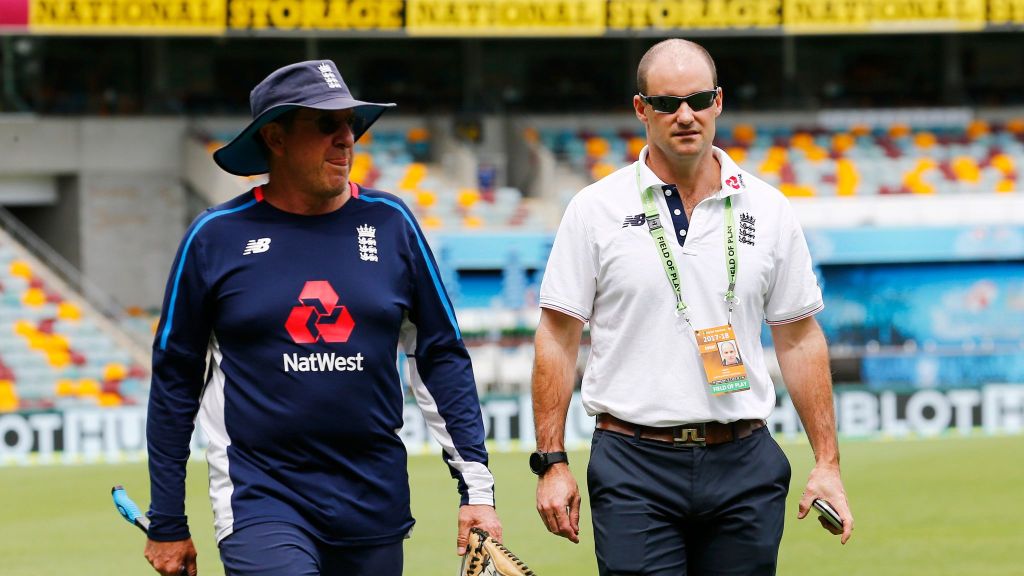
FROM the moment that Eoin Morgan retired, it was over. Morgan has led the transformation of the England One Day Teams and achieved what some of England’s greatest Captains failed to do in winning the World Cup. If the creation of the new team in 2015 was a joint venture with Trevor Bayliss and Sir Andrew Strauss, it was Morgan who set the example on the field.
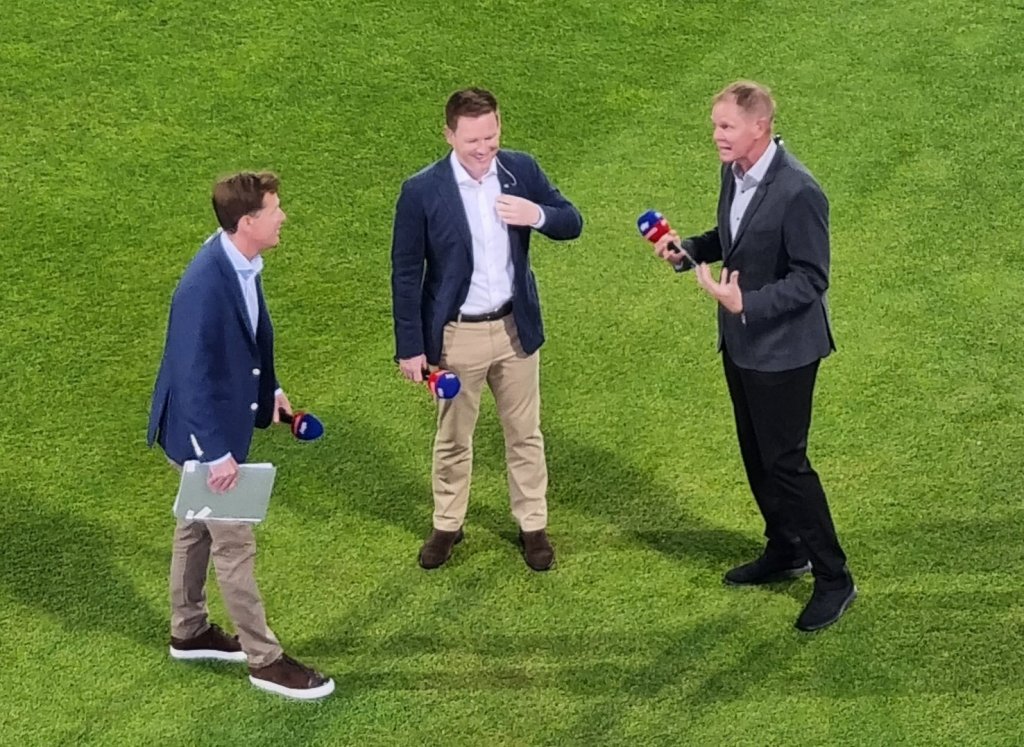
Not the best quality but its my own! Morgan now is a media man – here at the Old Trafford ODI against South Africa
Perhaps it was over from the moment that Jos Buttler broke the stumps at the end of the World Cup Final. Let’s face it – that team has never played together again. That was also when Bayliss stepped away. Since then England’s results have not been quite as good but they needed Morgan to get the team through Covid. By the time of the T20 World Cup last year, he was blocking a slot in the team and not giving the performance required. As his batting fell away, he was not able to set the same leadership example with that bat, and it became about words and culture. Indeed, Morgan’s values became a bit too dominant at times with the strange treatment of Dawid Malan and the refusal to move on with Alex Hales. In my opinion, Morgan should have retired sooner, but it is easy to say – you are a long-time retired. He is gone now. Buttler and Moeen Ali need to make decisions and not just ‘do what Eoin would do‘. Of course, they would all be aligned in many ways, but Buttler has to show his own true colours.
England has not done transitions well. Duncan Fletcher tried to replicate the 2005 team in 2006/07 and it led to a predictable 5-0 Ashes thrashing. The 2013 England Test Match Team imploded in a spectacular way. Even those few teams that manage success over many years change. The West Indies bowling attack had to accommodate the retirement of the fearsome foursome (Holding, Garner, Croft Roberts became Ambrose, Walsh, Marshall and Patterson). Australia went from Taylor, Slater, Boon, Jones, S Waugh, Border to Haydon, Langer, Ponting, Martyn, Clarke, Symonds).
What unites those two great sides of the past is that they ruthlessly picked the best players. Australia had to drop Michael Slater to create the Matthew Hayden / Justin Langer partnership and had to drop Ian Healy to allow Adam Gilchrist into the team.
England will need to do the same thing, and cannot ignore all the talent that was evident in the T20 Blast and The Hundred (Salt, Smeed and Jacks come to mind). Jason Roy has to get back into the runs, Liam Livingstone has to make meaningful scores and the bowlers have to tighten up or be changed. Even Adil Rashid is not quite the bowler he was.
In some ways, Ben Stokes has got the easier gig. It is perhaps easier to take over a failing team. However, I am not convinced by Buttler the Captain, and wonder if Moeen would be a better option. With Buttler I am reminded of Marcus Trescothick, who was passed over in 2003 when the England Captaincy went from Nasser Hussain to Michael Vaughan. Looking back now, it is clear that Vaughan was a good Captain, but he would not have coped well as a Deputy. Trescothick was the ideal deputy, but not the leader.
Buttler might yet prove me wrong, but he needs to step out of Morgan’s shadow. Moeen has a chance to turn things around, and if he was to do so it would be an interesting dilema. But difficult decisions might be needed to avoid another transitional failure by England.
Eoin Morgan has retired from International Cricket, stepping down from Captaincy. Some would say that it is a case of leaving before being pushed – he could not have continued much longer without scoring some runs. Despite this, Morgan will go down as one of the best England One Day Captains. Equally important as his success as a leader is that he was given the chance to succeed in the first place, and a lot of that credit must go to Sir Andrew Strauss.
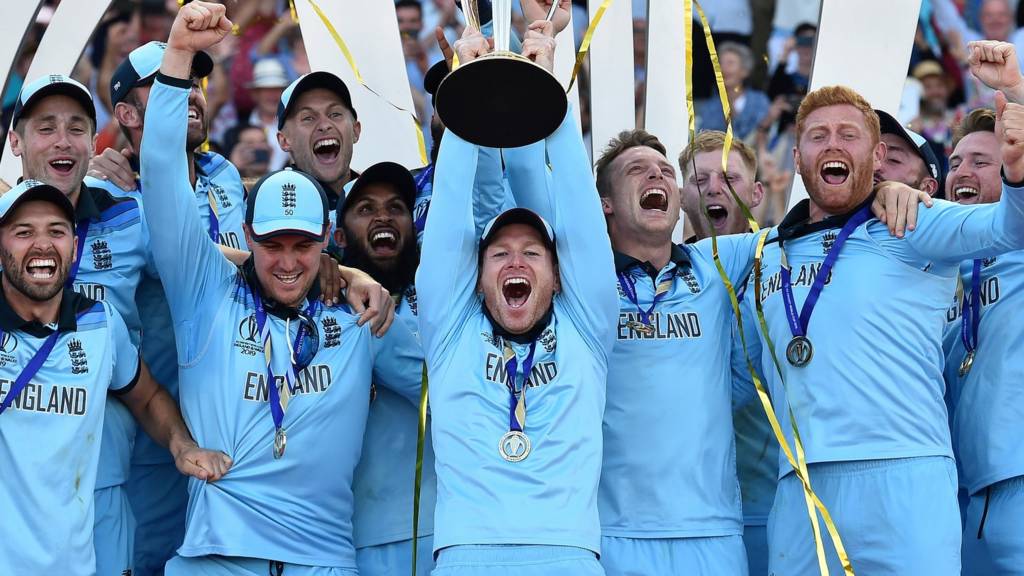
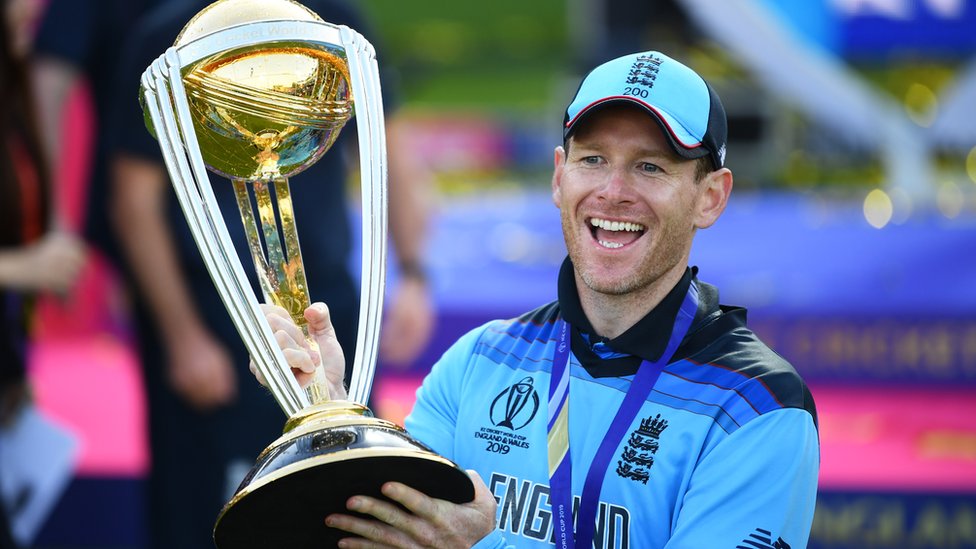
Finally England held the World Cup in 2019 – Picture from the BBC
World Cup 2015
One way or another, it all starts with the 2015 World Cup. Morgan had been around for a while and was probably England’s best One Day batter in the first half of the 2010s, along with Kevin Pietersen. He had failed to crack Test Match Cricket – the hope had been that Morgan would fill the Number 6 spot vacated by Paul Collingwood. Morgan had made a couple of hundreds, but it always felt like he would struggle technically – though he probably would have gone ok under the Ben Stokes / Brendan McCullum regime! In 2012, England had nearly managed to win a Champions Trophy somehow, but that flattered an England Team that, by 2015, was playing an outdated form of One Day Cricket under Sir Alistair Cook. Cook was a hero in the longer form of the game but was failing in the One Day arena both as batter and leader. England was terrible at One Day Cricket.
It was clear England needed to make a change before the World Cup, but every opportunity to do this was missed. The result was that Morgan was made England One Day Captain also immediately before the start of the World Cup. Morgan had no chance. He was given a squad that would have struggled in the 1996 World Cup, never mind 2015. For instance, Ben Stokes was not selected. The whole campaign was a disaster.
Morgan joined an ever-growing list of England Cricket World Cup Captaincy failures. It is a high-profile list, including Michael Atherton (1996), Alec Stewart (1999), Nasser Hussain (2003), Michael Vaughan (2007) and Strauss (2011) – all of whom only got 1 go at a World Cup.
Morgan went away to the IPL and waited for the phone call telling him he had been sacked as Captain. It felt like Morgan was going to be remembered as a decent One Day batter who was not quite able to make the most of his undoubted ability. However, when that phone call came, it would be Morgan’s big chance. From what I have read, Strauss was clear – Morgan was to be the One Day Captain, but only if he was certain he wanted the job. Unlike the others, Morgan would get a second go at the World Cup, and England meant business.
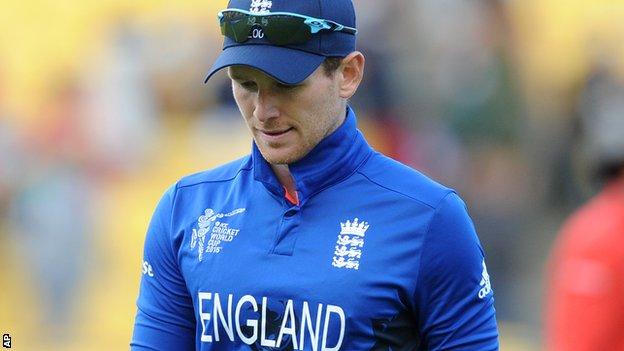
In 2015 Morgan thought it was all over – Picture from the BBC
2016: It all went mad
I remember the 2016 English Cricket season reasonably well. It was a summer when I spent a lot of time in the car, and it so happened that I must have been in the car on 30th August when England smashed past the 400 barrier, because I remember the incredulity of the Test Match Special Team when Alex Hales was battering the ball to all parts. By the end of the season, England was regularly getting well past 300 in 50 overs. Something had started.
It took the combination of Morgan, Strauss and Bayliss to set England on a new path. Picture from Sky Sports.
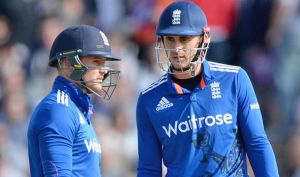
The obvious thing that happened was that England started to pick the right team, but it is a bit more subtle than that. It actually came down to deciding on an approach and assigning clear roles. The approach would be the very aggressive approach taken by New Zealand – but dialled up still further. So England finally started to pick Alex Hales and Jason Roy. England had the talent – people had been screaming for these two to be picked for a while – and it was time for that talent to be given a go.
Finally, England picked Hales and Roy. Picture from Express.
But while we all remember the 444/3, batting is only ever half of the equation. After the 2019 World Cup, we would hear about those early conversations between Morgan and new coach Trevor Bayliss. They quickly agreed on the need for a World-Class, wicket-taking spinner and Adil Rashid was to be that bowler, joining Moeen Ali.
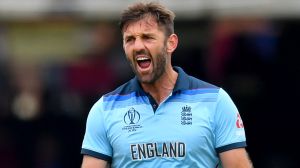
As important as the approach was the assignment of responsibilities. This most obviously applied to bowlers. Liam Plunkett was recalled and given that clearly defined role in the middle overs – yes the objective was to slow the scoring rate but the way to do this was to take wickets, alongside Rashid who would also be encouraged to attack, but with well-set fields offering protection. On the other hand, Moeen would often bowl in the Power Play, and batters would perish as they took liberties against Moeen, knowing Rashid was coming at them later on. It is worth noting that England only won the 2019 World Cup games in which Plunkett played, and it is something of a mystery that he was cast aside after 2019.
Plunkett had a clear role from 2015 to 2019 – Picture from Sky Sports
Batters too were given clear roles. Jos Buttler would be the finisher, Root would accumulate while Roy and Hales would try and hit the ball out of the ground. You might think this was all put together by a committee in the dressing room, but it still takes a leader to ensure the individuals in the team were playing in the way they were being asked to. With the batting, this meant he took the super aggressive option, showing the batters that it would be ok to get out caught at deep midwicket on the slog-sweep. Funnily enough, it freed him up and made him better as a batter. With the bowlers, it was about communication – be clear in terms of expectations but also be supportive.
It set England on a path to winning the World Cup in 2019. Remarkably, some would say England underachieved, failing to win the T20 World Cup and the Champions Trophy. That to me was churlish – England had been rubbish at One Dayers for so long that to win a World Cup was the stuff of dreams, dreams that I had not dared to dream since 1992.
2019
By 2019, it was clear England had a serious chance to win that elusive World Cup. I remember a conversation on Test Match Special when they tried to pick England’s All-Time best One-Day Team, and it was basically the entire 2019 team. Legends such as Graham Gooch, Allan Lamb, Robin Smith, Marcus Trescothick, Paul Collingwood and Darren Gough were not getting near that All-Time team.
However, Mike Brearley, Mike Gatting and Gooch had already found out the hard way that getting through an entire World Cup campaign was not so easy. England powered through the early stages of the World Cup but then got in a mess and had to win against India and New Zealand to make the semi-finals. Those early days in 2016 were important, but it was those last couple of weeks in the 2019 World Cup where Morgan would really earn his money. In those last couple of weeks, he had to get the best out of a team that was under incredible pressure, and yet even in the super over, he was calmness personified. No loss of temper, no public panic, no tantrums, no lectures. He just got on with it.
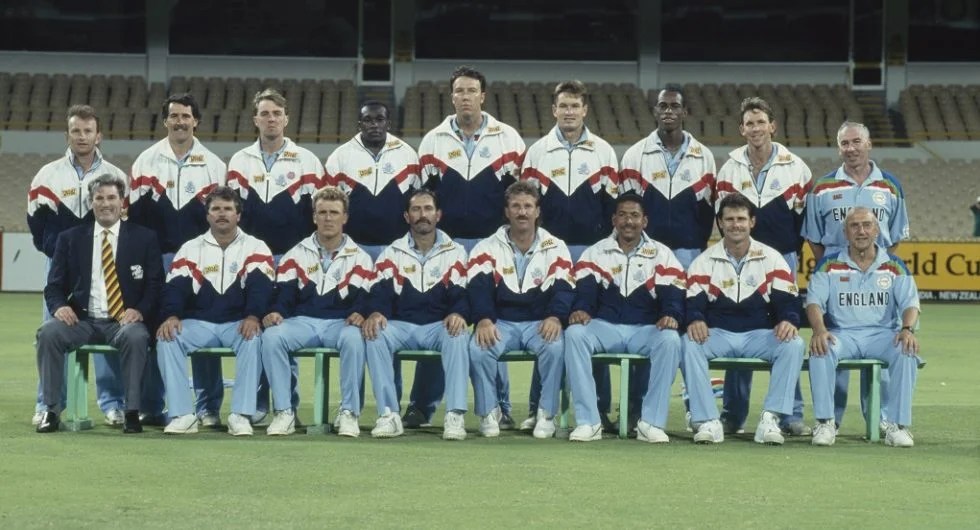
Gooches 1992 heroes were not getting near England’s All-Time One Day team.
Batting
A word about Morgan’s batting. We knew back in 2007 that Morgan was different. He had all those sweeps and reverse sweeps, and his wrists seemed to be made of rubber. In 1988 we could tell that Gatting was going for the reverse sweep practically before Allan Border started to walk in. With Morgan, he could leave it incredibly late before swishing the bat round in a reverse sweep. They all do it now, but then it was unusual. Then he became a six-hitter.
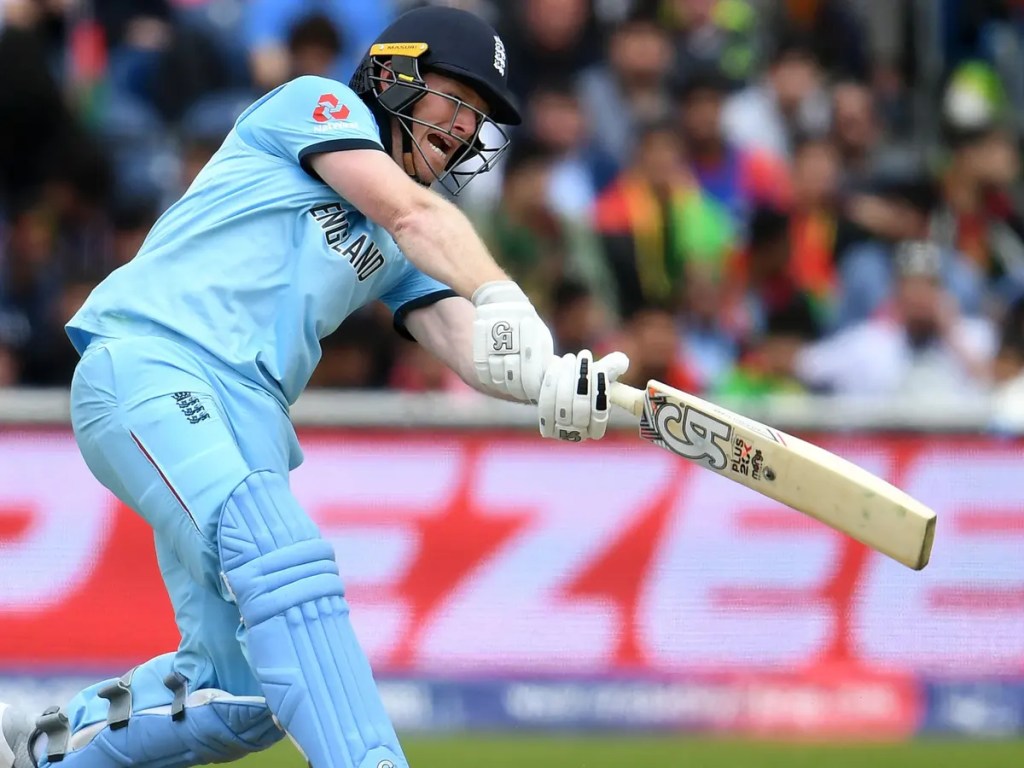
I was at the Old Trafford game against Afghanistan in 2019. It was only after he had hit about 5 sixes that we started to realise something mad was going on. That day he was outrageous – Old Trafford is not small and the sixes were way back, particularly the ones over long-on. Not only was it amazing batting, but it also showed the team how he wanted them to play. He was prepared to perish in the quest for quick scoring – and so the rest played the same way.
Morgan at Old Trafford – Picture from The Guardian where Ali Martin made the point on 18th June 2019 that ‘Eoin Morgan’s brutal 148 shows he practises what he preaches’. That was vital for the rest of the team.
In 2022 his batting seems relatively normal – alongside Liam Livingstone and Jos Buttler. But in 2010 alongside Collingwood, Strauss and Jonathan Trott it was remarkable.
Legacy
Whatever Rob Key says, Morgan’s legacy is the 2019 World Cup. It was so important that England used that home advantage. But to achieve that, he had to redefine the way England played the game. He had some proper players to work with, but he freed them up to succeed. The England One Day team had been a laughing stock from 1992 to 2015. Now they are feared. It is quite the transformation.
CWC19 will always be Eoin Morgan’s legacy – Picture from the BBC
 Cricketed