Ashes Day 3: Arrogant

My expectation was that I would be writing about a humbling defeat for England today, but they were not even able to get the game into Day 3. But I can not say I am very impressed with the attitude of either team.

Boof and Smudge

I don’t think we should have to put up with arrogance just because a team wins. I could not believe what I was reading when I saw Darren Lehmann moaning about the abuse that innocent, poor old Steve Smith has to cop from England fans. Smith, with the superior intellect to Monty Panesar.

Lehaman says that England fans – who he rather rudely referred to as ‘pork chops’ – should be better than that. Correct me if I am wrong, but it was not England who got caught with the sandpaper. The Aussies like to talk about Mike Atherton in 1994 – perhaps with some justification, but that was very different to the pre-planned nature of the sandpaper incident, and by the way, we all know that other team members knew what was going on, but they just did not get caught.

https://www.bbc.co.uk/sport/cricket/articles/c1w9n3q9evdo

Let’s be clear about this. England fans respect Smith’s ability – even if he is a challenging batter to watch – and are willing to accept that Smith, along with David Warner and Cameron Bancroft, served a punishment – even if it was a punishment that did not cause any of those players to miss an Ashes or World Cup.

However, we do not just turn round and pretend that the whole thing never occurred – any more than the Aussies like to point out English misdemenours. Smith and Lehmann should show some humility and stop looking for point scoring opportunities arising from the attrocious behaviour that went on under their leadership.

From our side of the world, it looked like the whole of Australia was full of anger after ‘sandpaper-gate’. The Australian team has often liked to tell everybody else where the line of fair-play lies. But it seems they stop worrying about such things when they win games of cricket.

England

This is not a balanced article. No. Because if the Aussies deserve some criticism for their attempt to pretend the sandpaper thing never happened, the English cricketers deserve to be roundly attacked for their attitude. They take arrogance to a new level.

Consider Zac Crawley, the undroppable opener. Here is a batter who has only played 1 game since September – and that was England’s warm up. No sh*t sherlock, but he looks out of form. Even Joe Root, rarely arrogant, strolled into the country just a couple of weeks ago – he looks out of form. Of course he does. Yet even after a terrible batting display and bowlers that looked tired after a very short first innings, this England team still won’t play warm-up games.

I am with Sir Geoffrey Boycott this time – it is a joke. And I am with Michael Vaughan – who wonders if the England fans will turn on this England team.

This England team keeps making the same mistakes. Even within a game, they make daft mistakes. Allow me to adapt a well-known phrase. To lose one wicket on the cover drive is unfortunate, but to lose 2 looks like carelessness. To lose 3 wickets on cover drives in 15 minutes?

That is arrogant and closed-minded. Frankly, I would be annoyed with my Stockport Georgians Under 11s for playing like they did – yet they still make out that they know what they are doing. Time to get into the real world.

Ashes Day 2 07:00: Can anybody bat?

I looked at my phone, and it was 65/2. Let’s watch a bit of ‘BazBall’ I said to myself – and by the time I got down the stairs, it was 76/4. A moment later, Joe Root chucked it away with a loose drive, and it was 76/5. While I had my first cup of tea of the day, wrapping myself in blankets and scrabling to get the heating on, I wondered about the quality of batting in this game.

Root’s shot did not help, and I considered going back up to bed. He does not look himself yet – perhaps all the talk about Root’s record down under is having an impact. He has 4 test matches left to show his class,  and he just needs to remember that while his record in Ausralia is not too bad – better than Graham Gooch’s. But his shot today was poor, and I quickly saw that his was the third loose off drive in 15 minutes after Ollie Pope and Harry Brook.

Don’t get me wrong, we have seen some great bowling, and sometimes it is the balls between the wickets that is the difference that leads to the poor shots later. But for me, its been poor shots from Zac Crawley, Pope (twice), Jamie Smith, Brydon Carse (twice), Mark Wood, Travis Head, Cameron Green…..and I am pretty sure I have missed some.

At the other end of the scale – Root (first time), Stokes (second time), Jake Weatherald, Steve Smith and Usman Khwaja got good balls.

Somewhere in the middle – I have some sympathy for Brook in the first innings and Jamie Smith in the second – both done on the pull shot when they did not quite go for it. For those two, the lesson is clear – go for a full-on pull/hook or leave the ball alone – do not be half-hearted.

What we have seen so far (except those two pull shots) is overly aggressive batting by England and overly defensive batting from Australia. Despite various ridiculous comments coming out of India about the Perth pitch, this pitch is not that bad (Spoiler India – your dustbowl pitches are bad). No, down in Perth, it is all about the lack of application and quality with the batting.

While I have been writing, England managed to drag themselves up to 164 all out, setting England a target of 205 for Australia. To be honest, it does not feel like it is going to be enough, but it is the highest score in the game

Right now, my 5-0 prediction is still safe.

What screen is the third umpire watching?

Shortly, Jamie Smith was given out caught on the pull stroke by the third umpire on DRS. This followed 5 minutes of video replays that showed quite conclusively that Smith missed the ball. It was very clear to see.

The commentators felt that the thirs umpire was influenced by Smith’s willingness to walk on without histrionics when it was given. I think Smith got it right – go with what the umpires say, even when they so obviously get it wrong. Otherwise, the crowd would be on him all series as another ‘moaning Pom’. It is even worse when you look at Marnus Labuschagne’s non dismisal yesterday on the review.

The umpires should never be affected by the player’s facial expressions – that just encourages players to try it on and ‘cheat’ – it leads to more appeals, less batters walking, and more catches being claimed unfairly.

We can not blame the players when the umpiring is so poor.

Ashes: Day -6

6 days to go!

What was the point of the warm-up?

Ben Stokes says it as it is. It makes him popular, but it means he can also be a bit frustrating in his attitude. Lord Botham was the same – and still is. After Botham walked back through a silent Lords pavillion in 1981, he never made friends with the Lords members again, and made his feelings known.

So it is funny to see these two England all-rounders on opposite sides of the conversation about preparation. But actually, these two differ completely when it comes to preparation. Stokes does not rely on game time for his preparation – he is clearly incredibly fit and pushes himself to the max. Every England fan wishes he pushed himself a bit less – but then he would not be the player he is. If you read Stokes’ 2019 diary, you see that mental preparation – thinking about the game and visualising it – is a big part of Stokes’ success.

Botham hated training and just wanted to be out playing. He has no time for the suggestion that these players play too much – he points at county cricket in the 80s. The great unknown, of course, is how much longer Botham might have played for if he had been fitter. But the modern approach to fitness has not been that successful for Mark Wood and Jofra Archer – and even Stokes has had his share of injury.

So Botham would have played more warm-up matches, Stokes says it is impossible. It certainly seems crazy to me that the England team arrived in Aus from different parts of the world on different flights at different times. The unified team departure from Heathow is long gone. I certainly feel it would have been better for the team to travel together from London as a team – that New Zealand series was a waste of time in my view. But Stokes does not make those decisions about schedules.

Of course, Engand played loads of games in 1986/7 – but they lost all the warm ups. Maybe it was still useful in terms of forming the team – it probably led to the selection of Bill Athey over Wilf Slack. England also have won warm-up matches on all of the disasterous Ashes tours of the past – and they were probably useful, even if they did not lead to series wins.

One thing that has changed, I suspect, is the quality of the opposition in these warm-ups. Like England counties, the opportunity to get one over the touring team was a major motivator in the past. Now, that is no longer the case. England have faced teams with hardly any first class experience in recent Ashes tours.

On balance, I agree with Stokes. It is pointless for England to turn up and play loads of games against poor quality opposition. Equally, they could not find time for fixutres. The game verses England Lions is of limited value, but at least players like Ollie Pope, Jordan Cox and Matthew Potts would be throwing themselves at it – it was a chance to get noticed by the selectors – and it as certainly sorted out who will bat at 3 for England for now.

Hazelwood’s hamstring

Josh Hazelwood is out of the first test match, along with Pat Cummins. In 2023, England had a golden opportunity when Nathon Lyon was injured at Lords – they did not take it – perhaps they were complacent with a major gap in the opposition bowling attack.

They must not be complacement – Scott Boland seems to cause a lot of problems, though I am not quite sure why. The Aussies will pull out another bowler from somewhere – they always do. But if England are to win the Ashes, they absolutely must take this chance. They have to win at Perth because Cummins and Hazelwood will come back fit and rested. It is England’s best chance of getting off to a winning start down under – which they have not done since 1986.

The Ashes: Doomed

My wife says I am very negative – she is predicting a 3-2 victory for England. Me and my eldest son (and all his PE teachers) are confidently predicting another 5-0 thrashing. For once, I really hope my wife is right and I am wrong (and it would not be the first time). But I just cannot see England regaining The Ashes this winter.

Let’s start with the last 25 years. England has only won 3 games in Australia since 2000. The first of those featured 2 players who made England debuts in 1990 (Nasser Hussain and Alec Stewart). The other two came, of course, in 2010/11, when England was a very strong team. Some have said that the current England team is up with the 2010/11 team.I disagree. The 2010 versions of Alastair Cook, Kevin Pietersen, Graeme Swann, Stuart Broad and Jimmy Anderson would walk into the current England team, and I reckon Andrew Strauss, Paul Collingwood and Matt Prior would probably get in too.

What if we go back to Mike Gatting’s team of heroes in 1986/7? If we include that tour, England have won 6 test matches down under since 1986 (2 in 1986/7, 1 in 1994/5, 1 in 1998/9, 1 in 2003/4, 2 in 2010/11). In that statistic is a real disappointment of England teams since 2010/11. Those England teams of the 90s did manage some draws and the odd win even – unlike those who have toured since 2011 or on 2006/7. The way England has fallen apart on those tours was really poor.

I think I have 2 major fears. Firstly, the way England bat. It can be very effective, but it can be disasterous. In both 2010/11 and 1986/7, England scored a lot of runs in a variety of styles – contrast Chris Broad and Cook with Lord Botham and Pietersen. England will need to show adaptability – or else they will be 200 all out on day 1 with the game over. If I am honest, this is what I expect to happen.

My other batting worry is that if England do put up a fight, do they have what they need to actually get over the line? England has played some amazing test match cricket under Ben Stokes, but they have not won a 5-match series. At home, in both 2023 and 2025, England should have beaten Australia and India – but they lacked the killer instinct to do so. I really hope we do not end up 3-2 down as a result of 1 terrible session somewhere.

Summary: England can win if they play the best cricket they can, for long enough. They probably won’t, though.

COME ON BOYS. PROVE ME WRONG.

ER – 11th Nov 25.

The Ashes 2025/6: it’s coming…

EVERYBODY wants to share their opinion about England and what the team will look like in Brisbane Perth. Those Aussies are never far away when it comes to commenting on English cricket. It is hilarious how ‘wound up’ the Australians get about this England team – its something about Ben Stokes that they just cannot handle.

It was this year’s Old Trafford test match that seemed to trigger the Austalian righteousness. As simple Poms, we know that the Australians draw the line of righteousness in cricket – no other country is permitted to do that. So, therefore, we knew we would have to be lectured from down under about the way that Stokes tried to get an early finish at Old Trafford. I must confess, however, that I think England were lucky that India pulled out after the two batters had got centuries – if I had been the batting captain, I would have batted right till the end – grind them into the dust as Steve Waugh would say. Mind you, the cricket down under must be awfully boring, given how much English cricket the Aussie fans seem to enjoy watching. And given any opportunity, they love to focus on those little moments from the past – Jonny Bairstow’s Lords moment of stupidity in 2023 (and yes, it was out).They still go on about Gary Pratt’s run out in 2005, and even that catch, off Allan Lamb’s boot, in 1985 gets a mention from time to time.

It was, therefore, no surprise when Ricky Ponting started to tell England what team to select, saying that England must pick Shoab Bashir. Some Poms asked if this is tactical from the Aussies – trying to impact our selection to help them retain The Ashes, but a quick look at England’s success in Oz tells you that the Aussies do not care what team England pick – England have won just 3 test matches down under this millenium, and only 6 since 1987, so I don’t think the Aussies need to bother what team we pick as it generally makes no difference.

Do England ever win down under?

I am not optimistic for England, but at least they do not start at ‘The Gabba-toire’ in Brisbane. It seems very kind of the Aussies to spare us from starting off in Brisbane, given that Mike Gatting was the last victorious England Ashes skipper at the infamous Gabba – and he needed heroics from one of England’s greatest in Lord Botham.

I have followed every Ashes series since 1990, and when you start to look at England’s record down under, it really is a tale of doom – except for 2010/11 which is a rare shining star. I have collected a few highlights below:

  • In 1990, England’s captain and best batter ended up in hospital for the first test match. Lamb ended up captaining that game, and the successful Graham Gooch / Mike Atherton partnership was broken. By the time Gooch was back, it was all falling apart, but at least England managed a couple of draws on that tour, and David Gower peeled off two memorable centuries before he fell out with Gooch and fitness and tiger moths.
  • In 1994, England had Devon Malcolm on a high to run through the Aussie flat-track bullies. Despite Ray Illingworth’s disdain for Malcolm, he was in the team and had recently roughed up South Africa. Unfortunately, Malcolm got chicken-pox. No disrespect to Phil Defreitas, but his medium paced long hop was just what Michael Slater wanted. England took two old stagers on that tour in Gooch and Gatting – who, alongside Atherton, were pretty much the only people who managed to stay fit all series. Despite an extraordinary run of injuries, England should have drawn that series. The victory at Adelaide lives long in the memory – inspired by the fit again Malcolm on the last day. They should have drawn – but in the end, they lost 3-1.
  • In 1999, England pitched up, and captain Alec Stewart claimed that England wanted to ‘compete’. The Aussies laughed, and both Atherton and Graham Thorpe speant the tour fighting back problems amongst other issues for Thorpe. England did compete and should have drawn the series too, but again they did not do so, though a bit of Aussie third umpiring perhaps made the difference when Michael Slater was given not out at Sydney (more Pommie whinging?).
  • In 2002, England were considered to be an improving team, but once again, it all fell apart. Nasser Hussain won the toss at Brisbane and (for some unknown reason) bowled on a batting belter, then we had the Simon Jones injury. We thought that tour was grim – again, the list of injuries was monumental – but actually, that tour was England’s second most successful tour of Australia in the 21st century it included a win in one game – soemthing that Stokes and Joe Root have not experienced down under.
  • In 2006, we thought that whaever happened could not be as bad as 2002/3, but once England had lost Michael Vaughan and Marcus Trescothick, the game was over. Steve Harmission made sure the tone was set with the widest of wides (think Jamie Overton at The Oval), but the worst thing was the way England kept tying to reform the 2005 side – even though a quarter of that 2005 team was injured. That was also the end of the Andrew Flintoff captaincy experiment – it never looked a good idea to me. The worst thing of all – this was where the 5-0 thing started to happen. They laughed at Stewart in 1999 – but actually, as a fan, I would love to see England ‘compete’ down under.
  • In 2013, it should have been alright, but it was a step too far for that England team and we should never have signed up to that itinerary of two consecutive Ashes series. Again, England tried to hold onto a team of the past – particularly Graeme Swann and Matt Prior were not fit. Mitchell Johnson bowled brilliantly, but Brad Haddin, an average batter at best, was made to look like Brian Lara. To lose that series 5-0 was a travesty and rightly ended careers. It should have ended Sir Alistair Cook’s captaincy.
  • 2017 was the year of the Ben Stokes incident. Perhaps that incident was the making of Stokes in the long term, but it was the breaking of England in that series. By that point, 5-0 was the standard score. I wonder if things might have been different if James Vince had not run himself out in the first test match – different for England and Vince.
  • It’s not fair to talk about 2021 too much – the challenges of Covid were too much. We should not forget the real human cost of that series and the aftermath – it can not be a coincidence that Thorpe’s decline came so soon after his sacking after that series. That being said, England made some odd decisions in that series – constantly avoiding playing the best combinations in the name of rest and rotation. It was a shambles, though I think it was 4-0, so perhaps an improvement?

With all of these tours, the main issue was that we had no idea what the team would look like for the first test match. Even in 2013, when England appeared to have a settled team, we did not know who would open the batting with Cook, and we picked Boyd Rankin out of nowhere out of a desparation for height and pace.

Why have 1 wicket keeper when you can have 2?

Half the time, we did not even know who the England wicket keeper was going to be. Whilst others will have covered the odd game due to injury, when you think Australia since 1989, you think of Ian Healy, Adam Gilchrist, Brad Haddin, and now Alex Carey.

For England? Jack Russell, Alec Stewart, Steve Rhodes, Warren Hegg, Geraint Jones, Chris Read, Matt Prior, Jonny Bairstow and Jos Buttler all come to mind, but even Sam Billings had to drive a few hundred miles to have a go behind the sticks. On virtually every tour, the England wicket keeper changed at least once – though not in 2010/11.

Who would have thought consistency behind the stumps might help?

The rare success

Why do I recap this voyage of pain – except as a sort of therapy for the England fan? Because I want to contrast it with 1986/7 and 2010/11.

In 1986, England did not have a settled team, but once they got out to Oz, Gatting was able to form a bubble around the team – easier then without social media. By the time Brisbane came around, little doubt existed about the top 6 (Bill Athey, Chris Broad, Gatting, Lamb, Gower, Botham). We knew that Phil Edmunds and John Emburey would play, and also Graham Dilly. The doubts surrounded the wicket keeper (Bruce French or Jack Richards) and the remaining fast bowlers (Defreitas, Gladstone Small or Neil Foster).

In 2010, England had even more certainty. In reality, we knew the entire eleven (Andrew Strauss, Alistair Cook, Jonathan Trott, Kevin Pietersen, Paul Collingwood, Ian Bell, Matt Prior, Stuart Broad, Graeme Swann, James Anderson, Steven Finn).

Of course, the Aussies ridiculed them, and in 1986, the England press joined in – see Martin Johnson (can’t bat, can’t bowl, can’t field). But it is clear that the first thing you need is a consistent team.

The second consistency between 1986/7 and 2010/11 is runs. England scored mountains of runs, with centuries from Broad, Gatting, Gower, Botham, Richards, Cook, Strauss, Trott, Pietersen, Bell, and Prior. Everyone goes on about needing a battery of fast bowlers – but England did not have many truly fast bowlers on those tours – Chris Tremlett, probably, being the exception. Otherwise, lots of wickets came from Anderson and Dilly. What England had was runs. To win down under, you need runs – apparently, the pitches have changed, and we now have day-night games, but I am convinced that the way to put the Aussies under pressure is to score more runs than they do. That pressure then helps get the twenty wickets.

The third consistency is spin. In Emburey, Edmunds and Swann, England could get wickets with spin, but they could also tie things up. England does not have a bowler who can  do that – so it is probably not worth dwelling on.

One other note. Yes, you need runs, but you need 5 bowlers. Stokes will be key. England got away with 4 and Collingwood in 2010/11 – but that approach was disastrous in 2013/14.

My 2025 team

Whatever the conditions and however you view England’s batting, England have no choice, and they must stick with the same top seven and keeper as did the work in the summer. History tells us that any changes now would be disasterous – however you might criticise Zac Crawley and Ollie Pope, I shudder at the memory of players like Michael Carberry and Mark Stoneman debuting in The Ashes. It is never the time for new blood.

Therefore, the places of Crawley, Ben Duckett, Pope, Root, Harry Brook, Ben Stokes and Jamie Smith are certain.

Equally certain is Shoab Bashir (if fit) and Gus Atkinson. Atkinson showed his class at The Oval, and England has invested too much into Bashir to back out now. After that, it is down to fitness (and even getting that far has doubts around Stokes and Bashir). The tendency might be to avoid picking both Jofra Archer and Mark Wood together, but I disagree. In 2021/22, England held back players in the first game, with a view to playing them in the second game when conditions would be different. The result of this was to condemn England to be 1 match down in the series before that second game. England has to be aggressive and put the best foot forward. That means Wood and Archer play. It is a risk that England runs out of energy later in the series – as happened against India – but their is no point getting to Sydney with fresh bowlers but being 4-0 down.

As for the wider squad, I would not take Chris Woakes or Liam Dawson. Woakes has struggled abroad, and Dawson played himself out of the team at Old Trafford. Nobody has a clue why England ever picks Jame Overton, least of all me, so he also stays at home. Sam Cook is doomed as well – finished off by The Hundred, but he also looked ineffective against Zimbabwe.

So, Josh Tonge and Brydon Carse should stay with the main team. Jacob Bethell will go with the main squad – I have no idea why, but he will. Rehan Ahmed should go as a second spinner – as much for his runs in the championship – and these are runs made in the top 3. Josh Hull and Sonny Baker should go with the Lions – but let’s not throw them into an Ashes series until we are 3-0 up. I need the last few rounds of the championship to work out who the other batters should be!

Likely Brisbane team – Crawley, Duckett, Pope, Root, Brook, Stokes, Smith, Atkinson, Wood, Archer, Bashir.

Prediction

Honestly, I think it will be 5-0 Australia. England will fight and push, but not quite win the key moments in each game. Hopefully, I am wrong.
Musings on the England v India test matches

Test is best

FIVE test matches, all of which required a fifth day. Surely, that says it all. 

In England, at least, test cricket really matters. Often it is said that young people do not get test matches, but it is certainly not the case for all. My 9 year old son has attended 2 cricket holiday camps this summer over 8 days, and during a lot of that time, the children were playing ‘test-match’ in the nets – as you would imagine, this is a mock test match with teams playing multiple innings over multiple days. The people that run the game would do well to speak to some of the children that go to these events and check up on what the 9 year old cricketers want.

Jonathan Agnew recently said that any cricket administrator who promotes 4 day test matches going forward should not be in the job. That is an over-simplification and does not recognise the problems the 5-day game faces in some parts of the world. We do need multiple formats and should view the variety as a strength of the game – indeed, the aforementioned  9 year-old loves  The Hundred as well, and test matches are not for everybody. But we cannot ignore the fact that we have had 5 test matches that all have gone to 5 days. We can not even blame the weather – except perhaps at The Oval where maybe 4 days would have been enough. The games needed 5 days for someone to win – and that was not enough at Old Trafford. Test cricket is the ultimate test and needs to be treated as such.

Was the test match format respected?

By the players? Absolutely. By the administrators? No. Not in the slightest. 5 test matches in 45 days is too much.

It has, of course, happened before – I have just been reading Gideon Haigh’s book about the 2010/11 Ashes, which similarly bemoans the schedule for that series. In that series, the losing Australians fell into disarray with injuries in the later games, but even England lost a key player in Stuart Broad due to injury.

In this series, it can not be said that the quality at The Oval was consistently high. It had its moments, but also, it saw some of the worst England test match bowling I have ever seen. The reason for this is that several of the best players were injured, and the backup players for England had not played enough cricket. Josh Tonge and Jamie Overton improved as the last game went on – though the England obsession with Overton is quite peculiar. Several players on both teams looked exausted – although it seems that Mohammed Siraj could have played 12 test matches on the bounce.

Of course, injuries are part of the game, and in all probability, the injuries of Rishabh Pant (two injuries for Pant) and Chris Woakes would still have happened if the test matches had been 10 days appart, as was traditional in England. But would it not be better if Ben Stokes, Brydon Carse, Jofra Archer, and Jasprit Bumrah were able to play all the games and have recovery time in-between. We would not need rest and rotation – just rest between games would be a start.

What about Injury Substitutes?

It is a no from me.

Test matches have not needed substitutes before – people used to just accept the rules rather than want to change them all the time. I was as frustrated as anyone when Sir James Anderson limped out of the 2019 Ashes on the first morning, but it is an unusual scenario and usually things even themselves out for both teams – that was spectacularly the case here with Pant and Woakes.

I would not have substitutes. But I would take seriously the duty of care that was neglected for Pant and Woakes, as it was for Paul Terry and Malcolm Marshall in 1984. Its great drama, but if it risks further injury, it is the wrong call to play, whatever the stakes. Team doctors, not players, should own decisions about whether players are fit to bat, and this should be written into player’s contracts. Woakes and Pant should not have been allowed to bat, but that does not mean we roll out subs. Instead, it means that teams might have to make do with 10 occasionally, and Allan Lamb would have had to get his third hundred in 1985 slightly quicker.

I suspect substitutes are on the way into cricket despite my misgivings – and the rules will be manipulated by teams creating more acrimony on the field. It is not a good look.

The toss of the coin

England won the toss 5 times, but only made the right decsion twice.

England won every toss, but Ben Stokes and Ollie Pope made some questionable decisions and some good decisions. At Headingley, Stokes chose to bat, and given India were 471 all out it sounds like a reasonable call, but this came after having been 430/3, and they needed another record chase in the final innings. It was the wrong call, but England got away with it.

Not so at Edgebaston. Stokes again chose to bat first, giving an India without Jasprit Bumrah the chance to bat first. It was the wrong decision and was a slightly arrogant decision – to continually claim to be able to chase any score goes wrong when the target gets past 500. At one point, India’s first innings evoked memories of Australia’s 601/7 at Headingley in 1989 after David Gower chose to bowl, having won the toss. In the end, India fell away a little bit, but the eventual 587 was plenty enough – nobody is going to win many games after conceding that sort of score.

Both at Lords and Old Trafford, it was a little trikier to make the right call. For me, Lords was a bowl first scenario, but England batted. That they made it to 387 was down to a gritty Joe Root performance. Lords generally flattens out, and India almost chased down the target they were set. At the same time, the 4th innings score was the lowest in the game. So perhaps Stokes was proven right.

Old Trafford is difficult. All the stats say bat first every time, but since the square has been turned around, it has been incredibly flat, particularly this year, so I can understand England’s reasoning. My view is that if you bowl first, you need to bowl the team out for 300 and take 7 wickets on day 1, and England did not quite make this, but bowling first was the only scenrio where Engand could bat once – the follow on not being an option with this tired bowling attack. I think it would have been a draw whatever England did given the way it turned out.

Ollie Pope was thrown into the last game at The Oval with a second string bowling attack. England were very unlucky to lose Chris Woakes on day 1 to injury in the field, but he surely only played due to the scarsity of other experienced options. Given that the top 5 had all tasted success in the summer, whereas the England bowling attack included Gus Atkinson and Jamie Overton, who had not played earlier games in the series, and did not include Stokes who was England’s bowler of the summer. It was a no-brainer to bat first – and the West Indies in the 80s and the Australians in the 90s would have certainly done this when 2-1 up, with the aim to score 600 and bat the opposition out of the game. As it turned out, the decision meant that India were never out of it, which was enough for Siraj

Can BazBall work over a 5 match series?

England are determined to play in a manner that is full of intensity – they will throw absolutely everything into beating the opposition. This has so far been a problem when it comes to 5 match series. It is like the old fashioned light bulb that shines more and more brightly – until it goes out. At the Oval, the bulb went out.

  • Against Australia in 2023, they were undercooked – that was where the golf criticism started. England were not up to full intensity until the third test match, by which point they were 2-0 down.
  • Against India away, they won the first game of the series before tailing off badly and losing the series
  • Here, they maintained that intensity through Lords, but by half-way through the Old Trafford game, the effort was showing.

The question for England is not whether they can go toe to toe with the Aussies down under. The question is whether they can maintain it over the series? I think the 2023 Ashes was probably an outlier – it has been a regular issue that they have started series well and declined. In a 3 match series, this is ok – it is almost beneficial. In 5 test matches, its a problem.

The greatest teams I have seen are the great West Indies and Australia teams. Those teams definitely possessed great cricketers, but even those great players knew that at times, they needed to let the game happen because the opportunity for dominance will come. Think of Shane Warne bowling negatively to Kevin Pietersen in Adelaide – and remember who came out on top.

I think England need to turn down the intensity at times because they can not maintain it at 105% for 5 test matches. Perhaps that equates to Stokes bowling less overs – because if Stokes had played at The Oval, England would have won the series.

Was the series as good as 2005?

No. Emphatically, no.

Of course, it is easy to accuse people like me of wearing the rose tinted glasses, that people of my vintage will never accept that the old days were not the best. But in 2005, people who had been inspired by 1981 were prepared to turn round and say that 2005 was better. I am not hearing anyone say that here.

Let’s talk about excitement first. I do not think we can say the series was truly exciting until we got to Lords. Yes, it had a few exciting overs (Bumrah to Harry Brook sticks out), but neither Headingley or Edgbaston were remotely close finishes. Old Trafford was about as dull as it gets – its time Lancashire got honest about the pitches. Lords and The Oval were peak excitement – and we had the rare scenario where both teams had the same first innings score. But Day 1 and 2 at Lords were cagey, close games – great cricket, but not of the 2005 vibe.

Even if no game was won by just 2 runs, you could make a case for saying that the series was as exciting as 2005. But when it comes to quality, I am simply not having it. It says it all that a memorable moment in Leeds came from a Bumrah no ball. Does Brook at The Oval equal Kevin Pietersen? Does Gill at Edgebaston equal Ricky Ponting at Old Trafford? Does Stokes at Old Trafford equal Andrew Flintoff at Edgbaston? Does Ducket at Headingley equal Michael Vaughan at Old Trafford? Who equals Andrew Strauss at  Old Trafford and The Oval? Does Siraj equal Shane Warne?

Of course, quite a few catches were dropped in 2005 – mostly by Pietersen. Quite a few catches went down in 2025. But I do not remember any point at Old Trafford where the cricket was as abysmal as England were at The Oval in 2025.

No. 2005 is safe. 2025 v India was an important series, full of excitment. But it they won’t look back on it in 2045 in the way we are looking back at 2005.

First Test Match: England v Sri Lanka – Day 1

Sri Lanka 236 (Dhananjaya 74, Woakes 3/32) England 22/0 (Duckett 13*)

I attended the first day at Old Trafford today.  While it had some interest, overall, it was a tedious day that did not deliver value for money for paying ticketholders.

Firstly, we saw a terrible start for Sri Lanka who were reduced to 6/3. Gus Atkinson and Chris Woakes were tight and brought about frustration from the openers. Mark Wood was again bowling fast – his first ball a mere 94mph, and Kusal Mendis got what Jonathan Agnew on the BBC referred to as a ‘horrible ball’. I am not sure what Mendis could have done as Wood got some steep bounce. Angelo Matthews inexplicably left a Woakes straight ball before Shoib Bashir profitted from some worrying low bounce, trapping Dinesh Chandimal LBW. It looked a typical Old Trafford pitch – except for the low bounce which is a mystery.

More wickets came after lunch with Prabath Jayasuriya unable to take advantage of a strange wicket off a no ball that was only called when the batter was almost off the field.  This brought together Dhananjaya de Silva and Milan Rathnayake who both played really well in a strong partnership. Ollie Pope set postive fields that Dhananjaya (74) and Rathnayake (72) profitted from, but retaining the leg slip led to the departure of Dhananjaya, who may well now wish he had gone for a big hit instead of clipping the ball directly to Dan Lawrence.

Up to this point, we saw lots of good cricket. Woakes, Atkinson, Wood, Bashir, Dhananjaya and Rathnayake all deserve a mention. The Sri Lanka top order were always going to struggle with the mostly good bounce – and the bad bounce, though the some of the dismissals were down to poor strokeplay and technique, as much as tight bowling. The first poor bit of cricket we saw was the wicket off a no ball. What made this unusual is that the no ball was for a third ball in the over being over height. The umpire had indicated two for the over, so Atkinson ought to have moved away from the bouncer. Luckily for Atkinson, it was not an expensive miss.

From then on, the quality of the cricket fell off a cliff for a myriad of reasons. Firstly, England kept dropping it short to Rathnayake, who, for a while, enjoyed one easy pull for over per over. We give Sri Lanka credit for getting up to 176/8, having been 92/6, but while Rathnayake played well, he was gifted some runs by England’s short ball obsession.

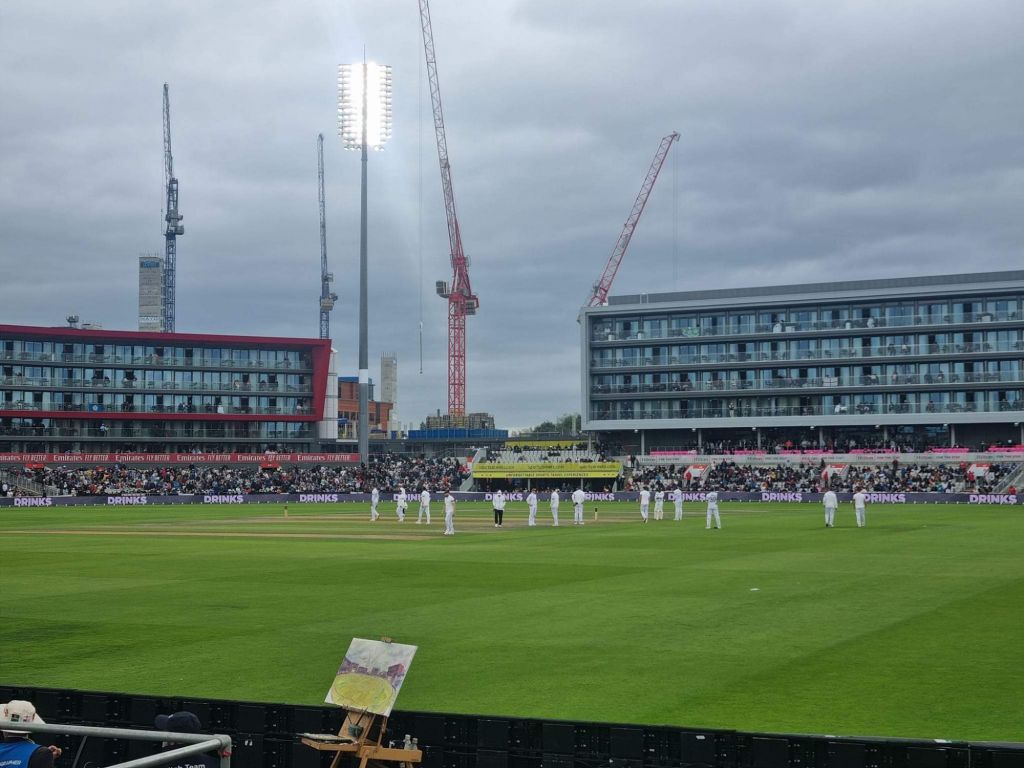
Ok it was pretty dark. But we have great big flood lights! And the artist could see to paint! It does present practical challenges but we cannot keep turning lights on and saying it’s bad light.

England should have finished Sri Lanka off before bad light became an issue – on two counts. Firstly, the over rate was so slow that England were way behind at lunch and tea where they should have been in terms of the number of overs bowled. It leads to a bored crowd. Secondly, England went for the short ball ploy. With Sri Lanka 8 wickets down, Pope made the same errors as Stokes, Root and Cook before him. What was needed was some straight bowling, but we saw one short ball every over and many seemed to whistle away through midwicket.

After a somewhat ineffectual spell by Matt Potts, whose bowling lacked the intent of the other seamers, Joe Root was inexplicably brought on when surely it was time for Woakes. From the crowd, it was not easy to tell when the umpires intervened exactly – this certainly needs an announcement through the PA system – but when Pope tried to bring Wood back, the umpires said no, Wood was too fast for the light. We found ourselves back in the farce where 4 fast bowlers were not allowed to bowl due to bad light – when all the flood lights were on. We saw this last year as well. I am sorry, but I can not comprehend how it can be bad light, with flood lights on and tail enders hitting fours. It makes no sense – you try and explain to someone who does not know much about cricket that test match cricket is the best format when we have this nonsense going on. You will not succeed.

Thus, we had the combination of slow over rate, strange captaincy, England’s choice of bowling short to tail enders and poor umpiring in relation to bad light all coming together to create tedium. I am certain the fast bowlers should have been allowed to bowl for longer, but equally, if the over rate had been up to scratch, we would have seen better cricket. The stewards were busy stopping beer snakes in the party stand – but we can not be surprised that the crowd are restless in these situations.

The one good bit of cricket late in the day was in the retention of positve fields, combined with tight bowling from Bashir and Root. England eventually got Rathnayake to go for a big hit, and he mis-cued before Vishwa Fernando and Asitha Fernando messed up the running, resulting in a final run out.

England were never going to prod and poke against Jayasuriya and Dhananjaya, so Ben Duckett, in particlar, and Dan Lawrence raced to 22/0, at which point Sri Lanka bought pace bowling on which resulted in the close. In the last half hour or so, the light was poor so this was perhaps fair enough. An hour earlier, though the light was not that bad and those big flood lights continued to shine. Yet we had to watch 14 over of easy spin, giftinh Sri Lanka an extra 20 or so runs.

My overriding summary of the day – if we have flood lights turned on, use them. If that means a different ball (pink or whatever), we need to go with that. Alternatively, bin the lights in test matches as they are totally pointless at the moment.

England will be batting in difficult wether today and I think they might live to regret not bowling Sri Lanka out for 150. Saying that, they probably will score 280, which will be enough to go on and win. 

Heroes to Zeroes

England have had some pretty bad experiences at the Cricket World Cup. Back in 1987, we thought Mike Gatting’s reverse sweep was a disaster, but that shot was played in a World Cup Final. We had no idea back then that World Cup Finals would become a distant dream after 1992. We thought we had plumbed the depths in any of 1996, 1999, 2003, 2007 and 2011, but then came 2015, which was truly grim. Remarkably, 2023 has made 2015 look like a success story. Without a doubt, 2023 is England’s worst-ever World Cup campaign. What are the common themes for England at Cricket World Cups?

  • POLITICS, CONTRACTS BEST PLAYERS MISSING: 1983, 1999, 2003, 2007, 2023
  • WRONG (OR OUTDATED) STRATEGY: 1996, 2011, 2015, 2023
  • WELL PREPARED, CLEAR ROLES, WELL LED: 1992, 2019
A RARE WIN – just about, and even then we nearly messed it up2019
GOOD – No shame in losing a final against that West Indies team1979
OK – The first World Cup or the year that England’s best players were missing due to the rebel tour1975
1983
FRUSTRATING – we should have won1987 1992
BAD – we had no expectations, but it was bad1996
2003
2007 2011 2015
REALLY BAD – we had no expectations but it was at home, and we went out before the tournament song was released. It was really, really, really bad.1999
TERRIBLE – we expected success and experienced terrible failure2023
A quick overview of England’s World Cup Pain

In 2023, the issues have been many and varied, but the number one word would be COMPLACENCY. This is something that seems to crop up a lot in English Cricket, and I find myself wondering why.

In fairness, it creeps in slowly. Sometimes, one player can be the difference between success and failure. In 1981 and 1986/7, England had struggled, but transformation was triggered by Lord Ian Botham. Sometimes, a change in attitude can have spectacular results – in 2009 England were bowled out for 54 by the West Indies, but a few months later regained The Ashes.

Sometimes, multiple things start to happen, but very slowly. In 2013 England won the Ashes at home, but things were ‘creaking’ – Jonathan Trott struggled while Graeme Swann bowled every over in pain as his body gave up. Yet a 3-0 win made England complacent – they thought by taking the same team over to Oz they would walk out with those Ashes. Yet actually, they needed to make changes. And as soon as Swann became ineffective, the tactics that had worked so well for England failed – because the three fast bowlers needed Swann to tie an end up. 1989 was similar for England – England tried to get one more series from the likes of Botham and David Gower – both the 1989 and 2013/4 Ashes teams failed spectacularly.

We see a lot of this in the 2023 World Cup. Like when Sir Andrew Strauss retired, the loss of Eoin Morgan changed the dynamics of the team – all of a sudden Jos Buttler had to set an example, and England was short of a quality batter. All of the team were a bit older, and several of the team were less fit and a bit less good. England’s tactics were confused and mixed up – but the original plan to attack very aggressively failed in India. Here we saw a lack of preparation we have often seen in World Cups, when The Ashes and World Cup fell in the same year. But it was not just a lack of immediate preparation – England have not played much 50 over cricket in recent years – Internationally or domestically.

But this year, the complacency also came from senior players who thought they could just walk into England’s team and dominate like they did in the lead-up to 2019. Moeen Ali’s self-belief had already been inflated by his call out of test match retirement last year, but actually Ali’s One Day Career should probably have ended after the 2019 World Cup, during which he was dropped. Ben Stokes was so certain of his own infallibility that he ‘unretired. This ‘unretire’ business needs to end’. They thought they were so good that they could even focus a bit of energy on Central Contacts during the tournament – something that also happened in 1999.

So, what is the answer? Well, it is not easy. You cannot expect England to tear apart a winning team. But the reality is that the team stopped winning a while ago – and yet England clung to a belief that when the 2019 heroes came back it would all be fine. The team was never put together to test that out. But the real answer is simpler than rest and rotation. The real answer is the need to focus on the here and now. England fell into a trap of looking at the team of the past – not the present. They did this in the 2006/7 Ashes – when the likes of Geraint Jones and Ashley Giles played and England tried to re-create the 2005 team. It never works.

Perhaps this all comes as a result of this endless talk of ‘cycles’. The World Cup cycle, the T20 cycle, that Ashes cycle….we will get to the end of this cycle and then make wholesale changes. It never has worked. Play to the here and now. All the time. Not to the past.

Old Trafford: Doom

A disappointing end. Australia had no right to draw a game in which they were thrashed. However, 2-1 up is a fair reflection. England were careless in Birmingham and are now paying for it.

Trouble for Test Match Cricket

I have a great deal of respect for the genuinely neutral cricket writer or broadcaster. Not many remain, but it is hard not to get overly swept away by negativity on days like yesterday and today. However, as a Day 4 spectator, I saw a few things that seriously question the viability of the format. I had my son with me, and I really wanted him to get ‘The Ashes’ bug like I did in 1993 and 1997. Though I was a tad older, so he still has time, I was full of frustration.

Weather

As for the weather itself, I am not sure that Old Trafford could have done too much more than they did. The covers look quite limited, but the ground does drain brilliantly. Let’s face it – given the Manchester weather – it would have to drain brilliantly. As a local, it does upset me that the bad weather always comes during Test Matches – if Manchester hosted the first game of the series it would not have been weather impacted as much as Birmingham was. However, it has to be said that the Old Trafford test match in 2013 was rained off, allowing England to win the Ashes in a lost cause, in a similar way to Australia here. In 2005 weather stopped England winning, and in 2019, the day 1 weather was fowl.

What needs to be looked at is more flexability and adaptation, allowing the maximum game time. And someone has to remember that 20,000 people are sitting in the ground, watching. Those tickets are not cheap.

Over Rate and Start and End times

When interviewed this morning, Joe Root suggested some sensible ideas around start and finish times. I agree with him. Test Match Cricket needs to start at 1000 if the weather allows it. The argument about peak time travel is outdated now. Weather permitting, cricket needs to go on longer to allow all the overs to be bowled. This would particularly apply in circumstances such as this weekend, where the forecast was so poor. However, where I disagree with Root is around over rates – the players need to make an effort here. The Over Rate on Day 4 was so poor that it was just dull to watch. England caught up, of course, because the spinners had to bowl. And I am winding up to that. But some things are so frustrating. At one point, we had to wait between balls every time while short leg came in with helmet for one batter, then went out for the other. It was painful – and applies to all formats of the game.

The ground environment

I love Old Traffod. A T20 at Old Trafford is a riot of fun. For the test match, it was all ‘serious’, trying to be ‘prim and proper’. The family facilities were poor and they tried to stop you moving between overs. I appreciate its more serious, but if the lighter environment creatws successful T20s, Test Matches need to take it on, rather than fight against it. I want Test Matches to live on. I loved it growing up, when it was more serious, but not many of my friends did. Test Cricket needs to help me to engage my sons.

Umpiring Standards, Lights, Floodlights, Safety and CONSISTENCY

In this test match, the umpiring was diabolical. LBWs that were plumb were missed, and Umpires Call ones were being given out. Obvious edges were missed. And then, we come to the light.

Test match cricket just has to stop this situation where the light is deemed poor, but gigantic floodlights are shining everywhere. It is utterly mad and looks terrible. If the floodlights work in One Day cricket, they work in test matches – and if the ball has to change, it has to change. If it is safe in a T20, it is safe in a test match. The site of an umpire in sunglasses suddenly deciding its too dark for Mark Wood to bowl when it had been fine an hour earlier is one of the most ridiculous things you will ever see. And try explaining it to a 7 year old, not that anybody bothered to explain it to the crowd (probably the announcer could not believe how ridiculous it was).

I am not sure how the process works – is a light meter reading taken every time an innings or day starts? However, I was at the ground, and the change in light between the start of the session and the end was simply so minor it was totally irrelevent. The light was so bad that two massive sixes were hit in the next overs off the spinners (note – sarcasm!). It makes no sense. England had to bat in awful weather at Edgbaston. Australia should have faced Wood before tea on Saturday.

The point here is consistency. If we have a genuine safety issue here, it applied in Birmingham in England’s second innings, and it applied all through Day 4. It did not suddenly appear. Test cricket has been played in much worse light. Test match cricket will not survive while the decisions taken by officials are so unreliable and weak. It applies to LBWs, light decisions, no ball calls…indeed, to every decision the officials take.

The new players are not coming through

With the exception of one or two, both teams was very similar to the ones in 2019. The England bowling attack was one of the oldest ever for England, and the 3 Australian fast bowlers were the same as in 2019.

Who are the players that we will see in the next series, and will they be fitter? One is beginning to wonder who will play the test matches – Root and Jonny Bairstow might be around in 2025, but Ben Stokes Jimmy Anderson, Chris Woakes, Mark Wood, Moeen Ali will not be. Despite the Crawley heroics, only Harry Brook looks truely at home in test match cricket of the younger players for England (the likes of Ben Duckett and Ollie Pope).

So what can be done?

England have shown that Test Matches can be played in a different way, a way that is a spectacle, and some other teams are starting to copy it. Australia have been snobbish about Baz-Ball, but they are lucky that the slightly dull style of cricket they play has held out for them. It would not have done so but for the rain.

The ICC has to tackle some of the issues raised above that swiftly reduses the game to a farce. And, of course, the Schedules need to be realistic.

What about the cricket we did see?

It was great from England, awful from Australia except for Marnus Labuschagne. He played a classy knock. Wood was brilliant (when the umpires let him be), Woakes bowled well, though Broad and Anderson were not effective.

Tactics

England played well and, as David Lloyd once said, ‘we bl**dy murdered them’. England were right to bat on, or else they might have had to bat again. I had no issue with the Birmingham declaration, but England threw that game away with bad catching and bad second innings tactics. As for Lords, Australia played well – I think the bouncers were a good tactic, the critics never suggested an alternative, and it took Joe Root to come up with the answer as he did in Manchester.

Wonderful Woakes

I wonder how much of the decision-making comes from Chris Woakes being around? A calm, sensible head, joining in with the madness but not getting carried away with it. It seems just what England neeed in the dressing room.

We can not be sure about that, but we can see that they needed him on the field. He has taken wickets and should have had one more, but for some reason, his early wicket on day 2 was given a no-ball. I have already made my views clear on the umpires – his foot was behind the line, so I do not know why it was given as a no ball, but anyway, he still got 5 wickets, it just took 17 minutes longer than it should have. Not only has Woakes taken important wickets, he stuck around to hit the winning runs in Leeds. Then he found time before the 4th test match to pop over to Stockport and spend some time with the Stockport Georgians Disabilities Team (my local club). What a great guy!

Zak, Jonny and Joe

Crawley had his moment at last. He has had a really good series but needed that big score. He played like a man possessed – if he can just be a little more selective, he will play for few more of these innings.

Bairstow is now looking match fit – at Edgbaston, he was not. He gave an interview yesterday where he basically said as much – he was never going to be the right choice as wicket-keeper at the start of the summer, and he will not be the right choice in India. His batting has never been in doubt since the start of last year.

Root continues to inspire. As soon as he arrived at the crease on day 2, I spotted his new bat lift and I knew that he had cracked the bouncer theory. Australia should have ‘yorked’ him first ball – that would have been interesting.

Back to London

So England must go to The Oval and win. A 3-1 loss is a BazBall failure. 2-2 is a fair result for two matched teams. I hope the Aussies are not too smug – they have a few issues too. Its been a great series. But I do feel it is papering over the cracks.

It pays to stay in

The great thing about cricket is that every time you think you have the answer, it evolves. So it is that the premise of this article was solid last week, but maybe not today!

After the second One Day International, I was ready to give Heather Knight the plaudits. In the T20 series at The Oval, Ellyse Perry nearly dragged Australia over the line singlehandedly with a load of sixes at the end. In Bristol, it was Knight who did get England over the line. That Bristol performance contrasted with what we see so often these days when teams over-attack and lose vital wickets – particularly when chasing.

Knight kept things simple and made sure she was around at the end. Knight did not try to ‘hog’ the strike, and so we were spared the scene that has blighted the Men’s Ashes this year – where the bowling team focus on getting the tailenders out, allowing Ben Stokes or Travis Head to keep hitting the sixes (Travis Head suggestion – try hitting his stumps). It worked well for Knight when Kate Cross was able to get a few boundaries.

Then Nat Sciver-Brunt tried to do the same thing and it did not work. It failed in two ways for Sciver-Brunt on Sunday. Firstly, she was not quite at her best – at her best she would have got a couple more boundaries or sixes. She was still brilliant by the way – it is a measure of how good she is. The second issue was that, whilst Sarah Glenn stuck around, she did not quite score enough runs. I would have sent Cross out yesterday. However, whilst one can say that England did not win the game on Sunday, the fact they were even in with a chance owed to the fact that Sciver-Brunt was in. Similarly, Knight needed to be in at the end for England to win in Bristol.

I saw something similar last week in the County Championship when Lancashire lost in Blackpool. Lancashire tried to play some ‘BazBall’ and should be applauded for attempting to chase a massive total. They needed to switch into defensive mode a bit sooner, and they ended up being bowled out. However, they nearly got the draw because Rob Jones batted almost till the end.

Within the last week, I have seen at least 3 limited overs games lost where a team failed to chase a total – once in the T20 Quarter-Final at Old Trafford when Lancashire slipped up, and twice yesterday when Surrey and Essex failed to chase targets. All three probably should have been won by the team chasing. In the QF, Jos Buttler was in and needed to stay in. In the Semi-Final, Surrey went too aggressive. In the final, Paul Walter failed to take advantage of some luck, going for a big slog and getting bowled.

This is not about ‘one size fits all’. Different games of cricket will need different tactics. But generally, I think it is true that batters need to put a high price on getting out. In the Men’s Ashes, England have been careless with wickets and it has cost them. I do not accept that England would be 3-0 up – the Aussies are too determined for that. But I think it probably would be 2-1 to England but for some poor batting choices made by all of Zak Crawley, Ollie Pope, Joe Root, Harry Brook, Ben Stokes and Jonny Bairstow. The point is not that they got out, but that they were set and could have scored runs quickly – but they got out.

England Men must look at this. I am all for positive batting and support ‘BazBall’. England have competed in this series in a way they did not in the previous series when they tried to play ‘proper cricket’ .However, they must remember that BazBall cannot be played in the dressing room. Once you are out, you do not score runs, and your style of play counts for nothing. Old Trafford will be tricky because of the weather, but the pitch will be a good pitch. Runs will be on offer for those who play well. Steve Smith will want runs. England need them too.

Design a site like this with WordPress.com
Get started