When Bob Willis uses words like marvelous (twice) and masterful, you take note. I was watching – though on Sky Television, on 2nd April 2004 when Graham Thorpe played his best innings.
I know Willis was more positive than his TV persona but he did not he throw praise around unless it was deserved. For Willis to react in such a way shows the brilliance of Thorpe’s 119 not out.
That tour of the West Indies in 2004 was a vital stepping stone for this England side. It was the highlight of Steve Harmison’s England career (see 7/12 at Sabina Park, Jamaica) and the emergence of England’s 4 prong pace attack for the 2005 Ashes. England made the decision to go with Geraint Jones instead of Chris Read following Alec Stewart’s retirement. Ashley Giles started to show how many runs he could grind out at number 8. Andrew Flintoff was established and growing in stature. We started to see what Michael Vaughan wanted his team to look like – except for the middle order. The likes of Andrew Strauss, Rob Key and Ian Bell would all emerge over the next year, but at that time England relied heavily on 3 ‘old pros’ – Mark Butcher, Nasser Hussain and Graham Thorpe.
It is worth noting that all 3 made vital contributions to that 2004 series win yet none would make it to the 2005 Ashes and they all must have known that they would be replaced before too long. Butcher was very unfortunate with injuries. Hussain ran out Andrew Strauss but still went out on a high. Thorpe got the closest to the Ashes and I would have played him that great 2005 series instead of Ian Bell. But Thorpe’s Barbados century was ‘classic Thorpe’.
For England fans, Graham Thorpe was a constant beacon of hope during the 1990s. His career seemed to have 3 phases – which spanned both of Brian Lara’s World records – Thorpe was on the field for both.
1993 to 1998
I know he was dropped in 1994 after the West Indies tour to make room for Graham Gooch and Mike Gatting but Phase 1 goes from 1993 to 1998. He made an impression early with a hundred on debut but early in his test match career he got criticised for scoring a lot of 80ish scores. I was always baffled because in those days an England 80 was pretty significant. In Australia in 1994/5 Thorpe was England’s best player. By 1997 he was a complete test match player and I always liked him at Number 5 behind Stewart and Hussain.
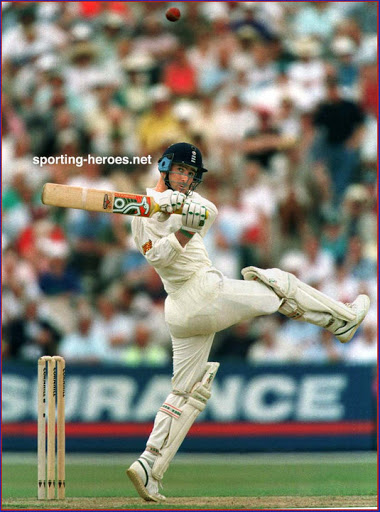
Emma John notes in her book ‘Following On’ that Thorpe reworked his technique after the 1994 West Indies tour to include that unique pull stroke which was so important to Thorpe over the years.
1999 to 2002
During this period Thorpe missed a lot of games. His career would be restricted by a back injury and his well documented personal issues. I honestly believe Thorpe would have been better supported by the 2020 England management and would probably have played 15 more test matches.
The strange thing was that he still scored runs when he did play, and this period featured an amazing innings against Pakistan in Lahore featuring just a single 4. He also made his top score of 200 not out against New Zealand in March 2002 – that was a game where Nathan Astle would knock off another 200. One thing to note about Thorpe’s 200 was that Flintoff would make his first test match century in partnership with Thorpe. I am certain Thorpe would have been a real help to Flintoff.
2003 to 2005
Thorpe made the dream comeback at The Oval against South Africa with a fine century which some would say was a better knock than the Barbados one. He then had a brilliant run of scores, and Wikipedia notes that in the two years between his comeback and his retirement he scored 1635 Test runs at an average of 56.37.
In this period, Thorpe played a bit differently. In his early career he would counter attack, usually coming in at 50 for 3. That led to all those 80ish scores. By the end of his career, Thorpe knew that once he had dug himself in, he could stick around.
Barbados brilliance
Thorpe scored 119 not out out of 226. England were 119 for 6. Thorpe and Harmison shared a last wicket partnership of 39 but Harmison scored just 3. Butcher and Flintoff played loose shots. Hussain was bowled attempting an off drive. Nobody looked comfortable other than Thorpe – though he did have to dig his way in.
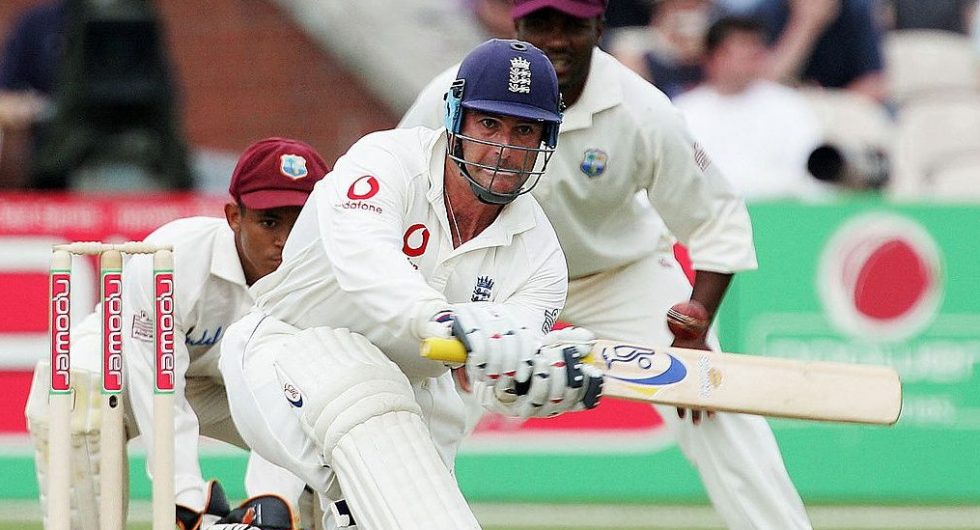
As England increasingly looked destined to fall short of the West Indies 224, Thorpe got more innovative. He walked down the crease to get his hundred. He unfurled a reverse sweep at one point. He got lucky with an early pull, but then played it to great effect. That little clip off his legs for 2 was a crucial shot.
As Emma John pointed out in her book, Thorpe was a really respected member of the England team. The reaction to Thorpe’s hundred here allowed an outpouring of that respect. Even the West Indians in the crowd were standing up when he walked into the dressing room.
In the last 20 years, England have had some fine middle order players. The likes of Bell and Joe Root come to mind. But Thorpe made runs against the best bowling attacks of the time. Amongst the players I have watched Thorpe would be one of England’s best left handed middle order players, second only to David Gower.

 Cricketed
One thought on “A marvelous, marvelous innings by Graham Thorpe. A masterful innings.”