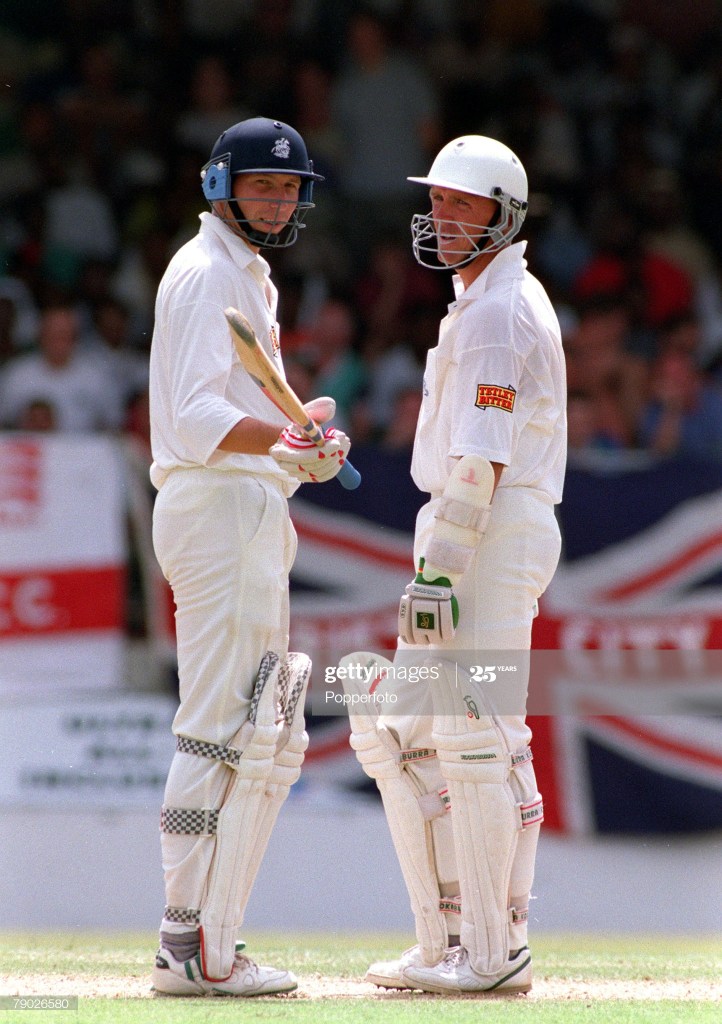
In 1994 Michael Atherton and Alec Stewart opened the batting for England against the West Indies and performed well with two 100 partnerships in the series. Stewart made the famous two centuries at the Kensington Oval. In 1996, Atherton and Stewart performed well, and Stewart made 170 opening the batting against Pakistan at Headingley. England had an opening pair ready for the post Graham Gooch era. But we are talking about 1990s England here. Nothing was ever simple.
For those who did not follow English cricket in the 90s, it was a time of strange and inconsistent decision making. You never knew what an England team would look like, but one thing you did know is that every season would include a debate about whether or not Alec Stewart should keep wicket in test matches.

Take the period of 1993 to 1996. In 93 Stewart did the entire Ashes summer behind the stumps. However, for the 93/4 winter tour to West Indies, Jack Russell was back in favour. In 94 we had an odd flirtation with Steve Rhodes, before we were back to Stewart keeping wicket in the first home test match against West Indies in 1995 (and we will ignore the incomprehensible decision to open the batting with Robin Smith). 1995 was unusual because we started with Stewart keeping but by the end of the series, Russell was back. Russell kept his place until the last home test match of 96 against Pakistan. 96 repeated what had happened in the 91 and 92 home seasons and the 90/1 and 92/3 away seasons – Stewart became a keeper at the end of a series to squeeze in an extra bowler. As England failed to win all these series, it is fair to say it never worked.
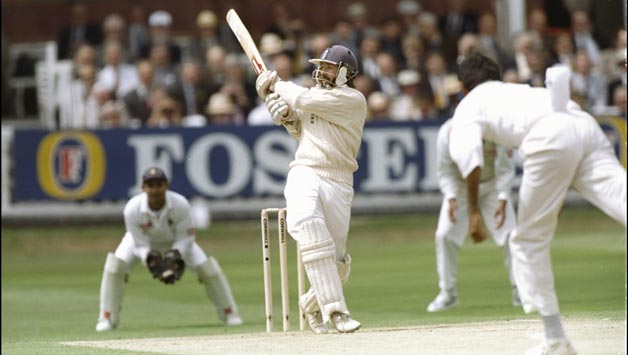
The dropping of Russell in 1996 really annoyed me. Just 5 games earlier, Russell had top scored for England against India at Lords – taking the score from 107/5 to 344. Just 5 games before that Russell drove the South African bowlers to distraction in partnership with Atherton at Johannesburg. In Russell’s final test match in England at Headingly in 1996, Stewart had scored the 170 and Nick Knight 113. At the Oval, Stewart opened but after that, in Zimbabwe, moved to 3 and Knight opened. That means that 3 of the players that made 100s in the summer of 96 found themselves dropped or in a different role. It was a total
shambles.
If you have read this far, you have probably already worked out that I always wanted Stewart and Atherton to open the batting, and I wanted Jack Russell to keep wicket. Looking back now I feel the same. But I will concede that this was never a simple issue. Gooch and Atherton had formed a good opening partnership and so generally when Atherton played, Stewart had kept wicket and batted down the order (93 being a case in point). England were always a class player short and were fixated on building a team around an allrounder batting at 6 (the ‘new Botham’). Jack Russell was always the victim of this. Another interesting point, hard to imagine in 2020, is that there were a lot of good openers playing county cricket – the likes of Hugh Morris, Martyn Moxon, Steve James, Nick Knight, Mark Butcher, Jason Gallian and Mark Lathwell. Astonishingly, in 1993 Lathwell had been considered such a talent that Gooch, at the time perhaps the best opener in the world and arguably the best England had ever had, was moved down the order resulting in top order containing 4 openers.
There are a number of reasons why I would personally have selected Stewart as opener, not a wicket keeper. Firstly, I believe Atherton played better with Stewart at the other end. They were, and remain, totally different character but they complemented each other perfectly. Stewart was an attacking opener, at his best against pace, happy to get the score moving. Atherton needed to dig in, but once in was hard to shift. Atherton was also captain and under huge pressure, as his presence had such an impact on the entire batting line up. We needed to take pressure off him and not put it on him. Stewart at the other end did this.
The second reason is that, to me, it always seemed that England were short of runs, not short of wickets. Using Stewart as a wicket keeper served to shorten the batting line up and reduced the effectiveness of one of our best players. As a pure batsman, Stewart’s average was close to 47 whereas his overall average ended up just below 40. Indeed, I was recently reminded that Stewart scored more runs in the 1990s than anyone else in world cricket (6407) at an average of just over 40). This stat is clearly going to favour Stewart because he played throughout the decade – Gooch was clearly a vastly superior player but he is 10th on the list of 90s run scorers but he retired in 1995. But I still wonder how many runs he might have scored if he had been consistently opening. England just did not have enough quality batting.
Look at the best sides of the last 40 years or so. West Indies in the 80s, Australia around the year 2000 and the world beating England side of 2011 all favoured a 4 man bowling attack with a keeper at 7 (though it must be said that Jeffrey Dujon, Ian Healy, Adam Gilchrist or Matt Prior could all have batted at 6). Continuing the international comparisons, it is notable that Kumar Sangakkara and AB De Villiers mostly did not keep wicket in test matches once they became so key to the Sri Lankan and South African batting line-ups.
The biggest issue of all though is that every time the Stewart swap occurred; the whole structure of the team changed. The opening partnership, the keeper, the slip cordon, the batting order…EVERYTHING! Contrast that to the England Team of 2010/11 when the England top 7 was unchanged for the entire tour.
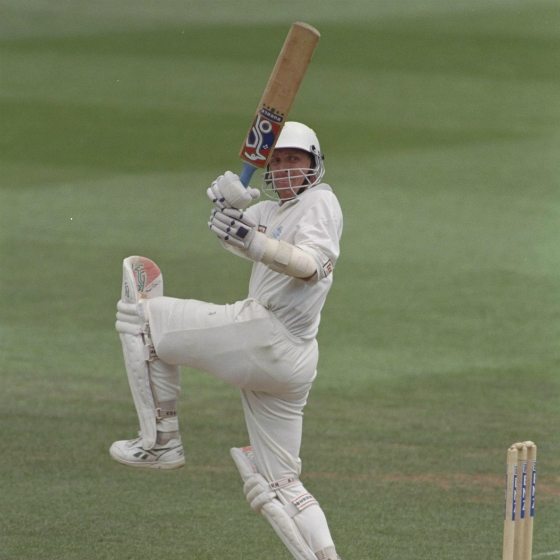
When I think of Alec Stewart, I think of the pull stroke, the white helmet and Kookaburra bat. Picture from Kookaburra.
With the arrival of David Lloyd as coach and the overdue departure of Raymond Illingworth, Stewart’s role generally became clearer. Stewart opened kept wicket in one day cricket – and that always made sense – after all, he was the 1992 keeper, and Russell playing in the 1996 World Cup was another moment of madness for England selection. In test matches, Stewart kept wicket and batted at 3 which advantageously allowed Nasser Hussain to bat 4 and Graham Thorpe 5. Memorably, Stewart as wicket keeper scored 2 fabulous hundreds at Old Trafford – 164 against South Africa in 1998, setting up a draw, and 105 against West Indies in 2000, rescuing England from 17/3. Even then, there were exceptions where Stewart did not keep wicket – the 1998 West Indies tour and Ashes test matches in 1997 (Trent Bridge scoring 87) and 2000 (SCG scoring 107). It is hard to ignore the fact that Stewart’s single century in Australia came when he was opening and not keeping.
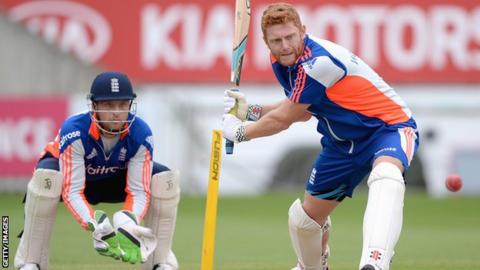
Twenty years later, you may be wondering why on earth this still matters? It matters because we have an abundance of keepers. Jos Buttler, Jonny Bairstow and Ben Foakes would seem to be enough options, but recently James Bracey was named in the training squad for the rescheduled West Indies series. In the 2015 home Ashes series, Buttler was in possession but in 2016 it seemed that Bairstow had made the position his own, before he was then moved to number 5 (Bairstow does not have the technique to be a test match number 5 in England). Not long after that, Foakes took an opportunity presented by injury, but a few games later was dropped. In the 2019 series, Buttler was batting in the wicket keeper’s number 7 spot but was not keeping wicket. Again, it made no sense.
Ed Smith would be well advised to take a look back at the 90s and the Stewart Saga. The lesson is actually simple. With Stewart, you could have gone either way, but you needed to make a decision and stick with it. By 2000, Stewart was established as first choice wicket keeper. It is no coincidence that the year 2000 saw England start to turn the tide, with series wins against West Indies and Pakistan. Consistency is key.

 Cricketed
One thought on “The Stewart Saga”